


Our Most Popular Categories
Trending
Health and Social Care
Safeguarding
First Aid
Care Certificate
Food Hygiene
Mental Health
Health and Safety
Animal Care & Training
Business Essentials
Career Bundles
Other Courses

- Yearly Subscription: Unlimited Access to 500+ Courses
- Level 3 Safeguarding Children and Vulnerable Adults
- Level 5 Designated Safeguarding Lead (DSL)
- Care Certificate Course
- Safeguarding Level 4 Training
- Health and Social Care Level 3 Diploma
- Accredited Dog First Aid, CPR and Grooming
- Trauma-Informed Care Training
- Level 3 Safeguarding Children and Vulnerable Adults
- Level 5 Designated Safeguarding Lead (DSL)
- Safeguarding Level 4 Training
- Designated Safeguarding Lead (Level 3 DSL Training)
- Safeguarding Adults Level 3
- Level 2 Safeguarding Children and Vulnerable Adults
- Level 3 Diploma in Nursing Assistant Training
- Safeguarding Adults Training Level 3
- Care Certificate Course
- Mandatory Training For Care Staff and Care Workers
- Level 2 Safeguarding Children and Vulnerable Adults
- Care Planning and Record Keeping in Health and Social Care
- Family Support Worker Training
- Training For Care Workers (Complete Package)
- Care Certificate Standards (1 to 16) + Level 2 And 3 Diploma in Health and Social Care
- Mandatory Training for Care Home Staff Training
- Accredited Dog First Aid, CPR and Grooming
- Pet Nutrition Diploma
- Pet First Aid and CPR Certification
- Pet Care and Psychology Diploma
- Learn to Launch and Grow a Pet Business
- Cat First Aid, CPR and Emergency Care
- Complete Dog Behaviour and Training
- Dog First Aid, CPR & Grooming + Safety for Pet Pros & Owners
- Care Certificate Standards 1-16 (The Complete Bundle)
- Training For Care Workers (Complete Package)
- Care Certificate Standards (1 to 16) + Level 2 And 3 Diploma in Health and Social Care
- Mandatory Training for Care Home Staff Training
- First Aid Essentials 1 to 6 Bundle
- Leadership and Management Courses
- Mandatory and Statutory Trainings For Adult Social Care
- Level 3 Admin PA and Secretarial Diploma Bundle
- Diabetes Awareness Training
- Baby Massage Training
- Employment Law Training
- Learn to Launch and Grow a Pet Business
- Complete Dog Behaviour and Training
- Dog First Aid, CPR & Grooming + Safety for Pet Pros & Owners
- Drugs and Alcohol Awareness Training
- Dog Care, Dog Grooming, and Dog First Aid Course Online

Offer Ends In
Use Code


The first thing you’ll need is an interest in this field. Coaching and mentoring qualifications are based on a combination of factors, including education, experience, and skills.
In this blog, we will explore what is required for coaching and mentoring qualifications. We will review industry-recognised qualifications and accredited coaching and mentoring. We will also discuss professional qualifications in coaching and qualifications for workplace coaching. Career pathways in coaching and mentoring will also be discussed.
So, let’s dig in.
Coaching and mentoring qualifications
Qualifications for mentoring depend on various factors. Most of it is on the field in which you want to practise. Here, what you have to do is research the programmes first and know about the facts that are required. Yet, three common qualifications that you need to consider are
- Education
Though formal education is not required, having a relevant degree in the field is beneficial. It will help you start your career as a mentor more professionally. Many universities offer specific mentoring programmes.
- Certificate
A certificate formalizes your knowledge and skills and is a valuable credential for your professional development.
- Experience
Practical experience is crucial for coaching and mentoring. You can gain experience by volunteering and doing internships. Working under the supervision of an expert can also help.
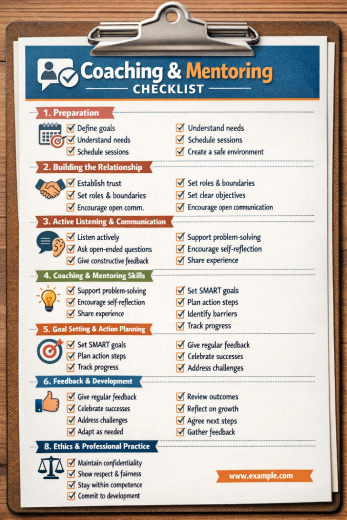
Industry-recognised qualifications
Industry-recognised qualifications refer to certifications from a specific industry or profession. They help demonstrate your necessary skills and knowledge. Obtaining them can enhance career prospects. Eventually, they help increase earnings and provide credibility within a profession.
Accredited coaching and mentoring courses
There are many mentoring courses available offered by various institutions or organisations. Among them, some options that you can consider are
| Association for Coaching (AC) | The Coaching Academy | The Oxford School of Coaching and Mentoring |
| The Association for Coaching offers a range of accredited courses and qualifications for coaches and mentors. Here, both beginners and experts can participate. | The UK’s largest coaching and training organisation is the Coaching Academy. They are known as the major coaching bodies, like the ICF and the AC. They provide online training as well. | The Oxford School of Coaching and Mentoring offers programmes, including diplomas and certificates. It is recognized by professional bodies such as the ILM and the EMCC. |
| University of East London | Henley Business School | University of Oxford’s Said Business School |
| University of East London courses at the postgraduate and undergraduate level. These programs cover topics like: -Psychology -Leadership -Coaching | Henley Business School offers coaching and mentoring on many levels. Their courses are designed for professionals who want to enhance their abilities. | The University of Oxford’s Said Business School also provides programmes with components. These programmes are excellent for anyone looking to improve their talents. |
Professional qualifications in coaching
Professional qualifications in coaching refer to certifications that show a level of proficiency. These qualifications are obtained through accredited training programmes.
One thing that you need to remember is that when considering professional qualifications, you need to research them first. You should research:
- Accreditation status
- Curriculum
- Faculty expertise and
- Credential body
Qualifications for workplace coaching
Qualifications for workplace coaching depend on the specific requirements. Among them, some of the common qualifications that people look for are:
- A completed coaching certificate
- Relevant experiences in the coaching field
- Bachelor’s or master’s degree
- Effective communication skills
- Empathic and have high emotional intelligence
- Should be skilled in solving situations
- Maintaining their confidentiality
- Respecting others’ boundaries
- Experience in the specific industry


Training programme for mentorship
Training programs for mentors ensure that they have the necessary skills. It helps to increase their knowledge and provides resources to support mentees.
To develop a comprehensive training program, you need to determine the goals first. Choose appropriate training methods and compile training materials. Design your training sessions and deliver training. Remember to discuss the effectiveness of the mentorship training and offer them ongoing support.
Mentoring certification programmes
Mentoring certification programmes are a formal recognition of expertise in mentoring. Essential factors you need to consider when evaluating mentoring certificate programs are
- Programs Curriculum
- Accreditation
- Reputation
- Faculty expertise
- Delivery format and
- Alignment with the goal
Career pathways in coaching and mentoring

Career pathways mostly depend on an individual’s interests. It also depends on their skills and professional goals. Some common pathways that coaches and mentors usually choose are
- Independent coach/mentor
- Corporate coach or mentor
- Executive coach
- Career coach
- Specialised coach or mentor
- Training and development specialist
- Educator or trainer
- Consult your advisor
It’s important to note that these are just a few examples of career pathways. If you are interested in a career in this field, you can explore various opportunities.
Coaching and mentoring skills development
Developing coaching and mentoring skills involves knowledge and experience. Here, you can start by participating in formal training programmes. Some other skills that might be helpful are
- Accessing your strengths and weaknesses
- Listening actively and asking open-ended questions
- Developing strong communication
- Goal setting and action planning
Online coaching and mentoring courses
- Udemy
- Coursera
- Linkedin Learning
- Coach Training Alliance
- Growth Institute
- The mentorship Academy
These are some reputable platforms where you can easily find online coaching and mentoring courses. Many courses are available for various skill levels and diverse interests. Before choosing any courses, you must research the materials to ensure they align with your career goals. You can also do a life coaching and mentoring course from CareSkills training.
FAQs
How do I become a mentor and coach?
Becoming a mentor and coach involves a combination of personal development. Yet, here are some steps that might be helpful for you:
➡️ Firstly, identify your expertise
➡️ Develop your skills
➡️ Gain experience
➡️ Build relationships
➡️ Consider enrolling on a certificate
What is another name for a life coach?
“Personal coach” is another name for a life coach. Other terms include wellness and transformational coach. However, the main goal of these coaches is to improve a person’s life.
Who is the most successful life coach?
There are a lot of coaches worldwide who become successful in their careers. Among them, some top ones are
➡️ Tony Robbins
➡️ Martha Beck
➡️ Jack Canfield
➡️ Cheryl Richardson
➡️ Brian Tracy
What’s the main difference between a coach and a life coach?
The differences between a coach and a life coach:
| Coach | Life Coach |
| Coaches are specialised in specific areas | Life coach works on a wide range of personal goals |
| They work with individuals or teams | A life coach works with individuals and focuses on personal development |
| The coach provides guidance and support to an individual in various areas of life. | A life coach focuses on helping an individual improve their personal life. |
Conclusion
In conclusion, obtaining coaching and mentoring qualifications is critical for you to succeed.
Certified courses and certifications provide the required skills. As the number of online courses has grown, professional development has become accessible. These qualifications open up a variety of job opportunities. Lastly, coaching and mentoring qualifications demonstrate a dedication to empowering others.




Level 3 Safeguarding Children and Vulnerable Adults
4.94.9Original price was: £119.00.£29.99Current price is: £29.99.
4499 Students

4 Hours

Level 5 Designated Safeguarding Lead (DSL)
4.94.9Original price was: £199.00.£49.99Current price is: £49.99.
4253 Students
7 Hours

3448 Students
17 Hours






0 responses on "What is Required For Coaching And Mentoring Qualifications?"