


Our Most Popular Categories
Trending
Health and Social Care
Safeguarding
First Aid
Care Certificate
Food Hygiene
Mental Health
Health and Safety
Animal Care & Training
Business Essentials
Career Bundles
Other Courses

- Yearly Subscription: Unlimited Access to 500+ Courses
- Level 3 Safeguarding Children and Vulnerable Adults
- Level 5 Designated Safeguarding Lead (DSL)
- Care Certificate Course
- Safeguarding Level 4 Training
- Health and Social Care Level 3 Diploma
- Accredited Dog First Aid, CPR and Grooming
- Trauma-Informed Care Training
- Level 3 Safeguarding Children and Vulnerable Adults
- Level 5 Designated Safeguarding Lead (DSL)
- Safeguarding Level 4 Training
- Designated Safeguarding Lead (Level 3 DSL Training)
- Safeguarding Adults Level 3
- Level 2 Safeguarding Children and Vulnerable Adults
- Level 3 Diploma in Nursing Assistant Training
- Safeguarding Adults Training Level 3
- Care Certificate Course
- Mandatory Training For Care Staff and Care Workers
- Level 2 Safeguarding Children and Vulnerable Adults
- Care Planning and Record Keeping in Health and Social Care
- Family Support Worker Training
- Training For Care Workers (Complete Package)
- Care Certificate Standards (1 to 16) + Level 2 And 3 Diploma in Health and Social Care
- Mandatory Training for Care Home Staff Training
- Accredited Dog First Aid, CPR and Grooming
- Pet Nutrition Diploma
- Pet First Aid and CPR Certification
- Pet Care and Psychology Diploma
- Learn to Launch and Grow a Pet Business
- Cat First Aid, CPR and Emergency Care
- Complete Dog Behaviour and Training
- Dog First Aid, CPR & Grooming + Safety for Pet Pros & Owners
- Care Certificate Standards 1-16 (The Complete Bundle)
- Training For Care Workers (Complete Package)
- Care Certificate Standards (1 to 16) + Level 2 And 3 Diploma in Health and Social Care
- Mandatory Training for Care Home Staff Training
- First Aid Essentials 1 to 6 Bundle
- Leadership and Management Courses
- Mandatory and Statutory Trainings For Adult Social Care
- Level 3 Admin PA and Secretarial Diploma Bundle
- Diabetes Awareness Training
- Baby Massage Training
- Employment Law Training
- Learn to Launch and Grow a Pet Business
- Complete Dog Behaviour and Training
- Dog First Aid, CPR & Grooming + Safety for Pet Pros & Owners
- Drugs and Alcohol Awareness Training
- Dog Care, Dog Grooming, and Dog First Aid Course Online

Offer Ends In
Use Code


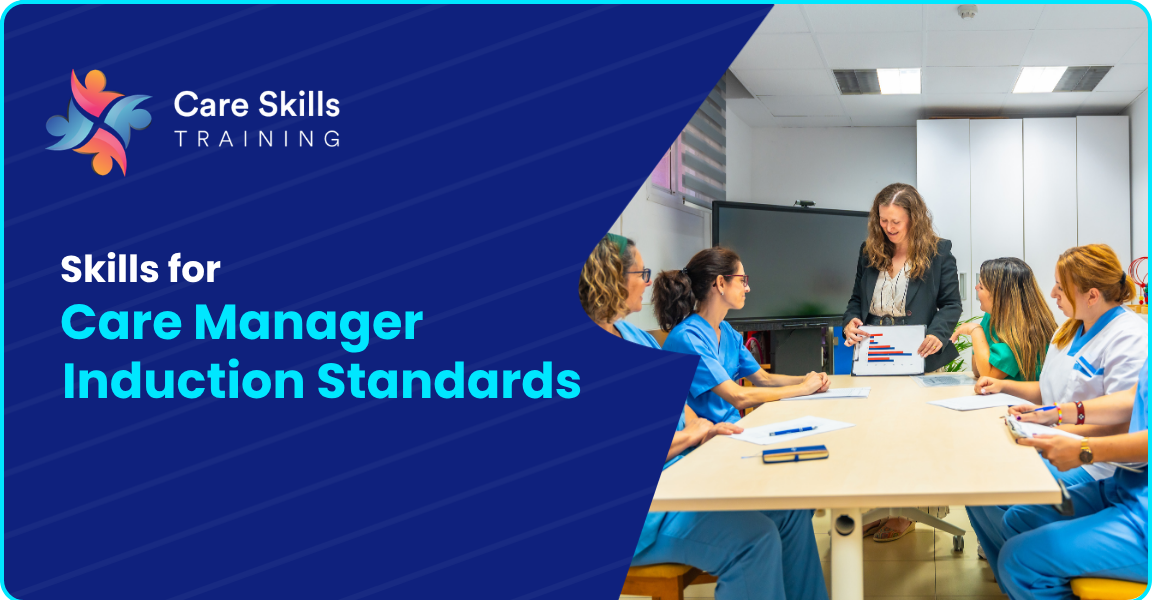
New care managers often start their roles without structured induction. In UK adult social care, this leads to inconsistent service quality, compliance gaps, and CQC scrutiny.
So, what are the Skills for Care Manager Induction Standards? They are a set of standards that define what new and aspiring managers in adult social care should know within their first six months. Skills for Care publishes them, covering areas from leadership and governance to safeguarding.
This blog shows what the Manager Induction Standards are. It explains what they are, who they apply to, and what each of the 11 standards covers. It also walks through how to complete them step by step. Explore more.
What are the skills for care manager induction standards?
The Manager Induction Standards, often shortened to MIS, are a national framework for adult social care in England. They define the knowledge and skills a manager needs to run a service safely and effectively, ideally within the first six months in post.
Skills for Care, the workforce development body for adult social care, publishes and maintains the standards. The current version was updated in 2023 to reflect changes across the sector, including the new CQC inspection framework and integrated care systems.
The standards are knowledge-based. There is no exam, no assessor visit, and no pass or fail. Managers work through each area, assess their own understanding, and gather evidence of learning as they go.
They are not mandatory. However, CQC expects registered managers to be properly prepared for their role, so many providers use the standards as proof of a structured induction.


Who Are the Standards For?
The standards apply to anyone managing, or preparing to manage, an adult social care setting in England. Whether you’re a registered manager, deputy manager or aspiring manager, they provide a structured induction into care management.
| Role | How the Standards Apply |
| New managers | Work through all standards within the first six months in post |
| Deputy managers | Prepare for a future step up into a management role |
| Experienced managers in a new service | Refresh knowledge and adapt to a different setting |
| Aspiring managers | Build evidence of development before promotion |
| Frontline care workers | Not covered. New care staff follow the Care Certificate Standards instead, while managers complete the Manager Induction Standards. |
Evidence gathered while working through the standards can also support a Level 5 Diploma later. Many employers use the framework as part of a good induction programme for new managers.
What are the 11 manager induction standards?

The 2023 Manager Induction Standards framework contains 11 standards. Together, they map out everything a new manager needs to understand, from leading a team to protecting the people in their care.
Each standard is a knowledge area, not a task list. You work through them at your own pace, ideally within six months, and gather evidence of your learning as you go.
Here are the 11 standards and what each one means in your day-to-day role:
1. Leading and managing in adult social care:
This standard focuses on the manager as a leader. Teams copy what their manager does, not what they say. It also introduces the Leadership Qualities Framework, a simple guide to what good leadership looks like.
2. Supporting and developing teams:
Supervision, appraisals, and mandatory training are three essential terms for developing teams internally. At its core, this standard is about keeping good people. Staff stay where they feel supported, and that support starts with the manager.
3. Regulation and governance:
CQC requirements include policies, audits, and legal duties. It sounds dry, but this is the standard that keeps a service safe and its registration secure. Managers should also ensure health and social care policies and procedures remain up to date and reflect current legislation and CQC expectations.
4. Effective communication:
Communicating with staff, families, and professionals, and getting the tone right for each. It also covers the hard conversations no one enjoys, but every manager has to have.
5. Working with partners:
No care service works alone. This standard covers building strong relationships with the NHS, local authorities, mental health professionals, and other services connected to the setting. Effective partnership working improves continuity of care by encouraging collaboration between health, social care, and community services.
6. Leading a person-centred service:
The people receiving support stay in control of their own care plan. Understanding the principles of person-centred care helps managers make decisions that respect individual preferences, dignity, and independence.
7. Safeguarding and mental capacity:
Let’s say a bruise, a missed meal or a resident gone quiet in a company. This standard builds the judgement to spot when small things are serious, and covers the Mental Capacity Act in practice.
8. Making decisions:
Two carers sick at 6 am, a complaint before lunch or decisions arrive fast in care management. This standard helps managers make them calmly and stand by them.
9. Managing resources:
Budgets, recruitment, workforce planning, and delivering outstanding should be cared with the resources available. Money and staffing take up more of a manager’s week than most expect, so this standard earns its place quickly.
10. Learning and innovating:
Learning from incidents, feedback, and complaints, then turning those lessons into real improvement. Good services are not the ones that never make mistakes, they are the ones that learn from them.
11. Personal development and wellbeing:
Looking after your own growth, resilience, and wellbeing is important as a manager. A burnt-out manager cannot run a healthy service. So, Continuing Professional Development (CPD) ensures your knowledge stays current as regulations and best practice evolve.
You do not need to start at standard one. Begin with the areas where your knowledge feels weakest. For most new managers, that means regulation, safeguarding, and resources.
How to complete the manager induction standards?

Completing the Manager Induction Standards involves self-assessment against each standard, a development plan to close any gaps, and evidence of learning gathered along the way. A line manager or senior colleague then confirms completion, ideally within the first six months in post.
There is no enrolment process and no exam. The standards are self-directed, so the pace and order are yours to set. Most managers follow the steps below.
Step 1: Read the standards
Start with the current 2023 version, available free on the Skills for Care website. Read it once without pressure. The aim is familiarity, not memorising.
Step 2: Self-assess against each standard
Rate your confidence against all 11 standards honestly. Skills for Care provides a self-assessment tool for this. Nobody sees your ratings, so there is nothing to gain from generous scoring.
Step 3: Agree a development plan
Take your gaps to your line manager or the service owner. Agree what learning you need, including any mandatory training, leadership programmes or local support available.
Step 4: Close the gaps, weakest areas first
Start where the risk sits, usually regulation, safeguarding, and resources. The free Introductory Modules for Managers follow the standards directly, and structured training and local support programmes can cover several standards at once.
Step 5: Gather evidence as you go
Keep a simple file of your learning. Certificates, supervision notes, reflective accounts and records of practice all count as evidence. Keeping digital training records and monitoring progress throughout the induction period also makes it easier to demonstrate compliance during inspections.
Step 6: Get signed off
Once every standard is covered, your line manager confirms completion and signs the certificate. Keep it safe. It is useful evidence of structured induction when CQC comes calling.
The whole process fits around a working week. Little and often beats a panicked weekend with the full document. Ten focused minutes a day gets you there well inside six months.
FAQ
What are the common induction standards?
The Common Induction Standards are eight standards covering the basics for new care workers in England: their role, personal development, communication, equality, duty of care, safeguarding, person-centred support, and health and safety.
What is an induction checklist?
An induction checklist is a document that lists everything a new starter must cover during their induction, such as policies, training, and introductions. Managers use it to track progress and confirm nothing gets missed, with each item signed off as it is completed.
What are the 7 qualities of a good manager?
A good manager shows seven key qualities: clear communication, empathy, decisiveness, integrity, accountability, adaptability, and the ability to develop others. In care settings, these qualities shape both the team’s morale and the standard of care people receive.
Conclusion
The Skills for Care Manager Induction Standards give new and aspiring care managers a clear framework for their first six months. The 11 standards cover the knowledge the role demands, from regulation and safeguarding to managing resources, and completing them means self-assessment, planned learning, and evidence gathered along the way.
Becoming a care manager is a big step, and nobody expects you to know everything on day one. The standards exist so you do not have to figure the role out alone.
If you’re preparing for your first management role, completing the Manager Induction Standards alongside structured leadership training can help you develop the confidence and evidence needed for CQC inspections and future qualifications such as the Level 5 Diploma.




Level 3 Safeguarding Children and Vulnerable Adults
4.94.9Original price was: £119.00.£29.99Current price is: £29.99.
4499 Students

4 Hours

Level 5 Designated Safeguarding Lead (DSL)
4.94.9Original price was: £199.00.£49.99Current price is: £49.99.
4253 Students
7 Hours
-
3448 Students
17 Hours









0 responses on "Skills for Care Manager Induction Standards"