


Our Most Popular Categories
Trending
Health and Social Care
Safeguarding
First Aid
Care Certificate
Food Hygiene
Mental Health
Health and Safety
Animal Care & Training
Business Essentials
Career Bundles
Other Courses

- Yearly Subscription: Unlimited Access to 500+ Courses
- Level 3 Safeguarding Children and Vulnerable Adults
- Level 5 Designated Safeguarding Lead (DSL)
- Care Certificate Course
- Safeguarding Level 4 Training
- Health and Social Care Level 3 Diploma
- Accredited Dog First Aid, CPR and Grooming
- Trauma-Informed Care Training
- Level 3 Safeguarding Children and Vulnerable Adults
- Level 5 Designated Safeguarding Lead (DSL)
- Safeguarding Level 4 Training
- Designated Safeguarding Lead (Level 3 DSL Training)
- Safeguarding Adults Level 3
- Level 2 Safeguarding Children and Vulnerable Adults
- Level 3 Diploma in Nursing Assistant Training
- Safeguarding Adults Training Level 3
- Care Certificate Course
- Mandatory Training For Care Staff and Care Workers
- Level 2 Safeguarding Children and Vulnerable Adults
- Care Planning and Record Keeping in Health and Social Care
- Family Support Worker Training
- Training For Care Workers (Complete Package)
- Care Certificate Standards (1 to 16) + Level 2 And 3 Diploma in Health and Social Care
- Mandatory Training for Care Home Staff Training
- Accredited Dog First Aid, CPR and Grooming
- Pet Nutrition Diploma
- Pet First Aid and CPR Certification
- Pet Care and Psychology Diploma
- Learn to Launch and Grow a Pet Business
- Cat First Aid, CPR and Emergency Care
- Complete Dog Behaviour and Training
- Dog First Aid, CPR & Grooming + Safety for Pet Pros & Owners
- Care Certificate Standards 1-16 (The Complete Bundle)
- Training For Care Workers (Complete Package)
- Care Certificate Standards (1 to 16) + Level 2 And 3 Diploma in Health and Social Care
- Mandatory Training for Care Home Staff Training
- First Aid Essentials 1 to 6 Bundle
- Leadership and Management Courses
- Mandatory and Statutory Trainings For Adult Social Care
- Level 3 Admin PA and Secretarial Diploma Bundle
- Diabetes Awareness Training
- Baby Massage Training
- Employment Law Training
- Learn to Launch and Grow a Pet Business
- Complete Dog Behaviour and Training
- Dog First Aid, CPR & Grooming + Safety for Pet Pros & Owners
- Drugs and Alcohol Awareness Training
- Dog Care, Dog Grooming, and Dog First Aid Course Online

Offer Ends In
Use Code


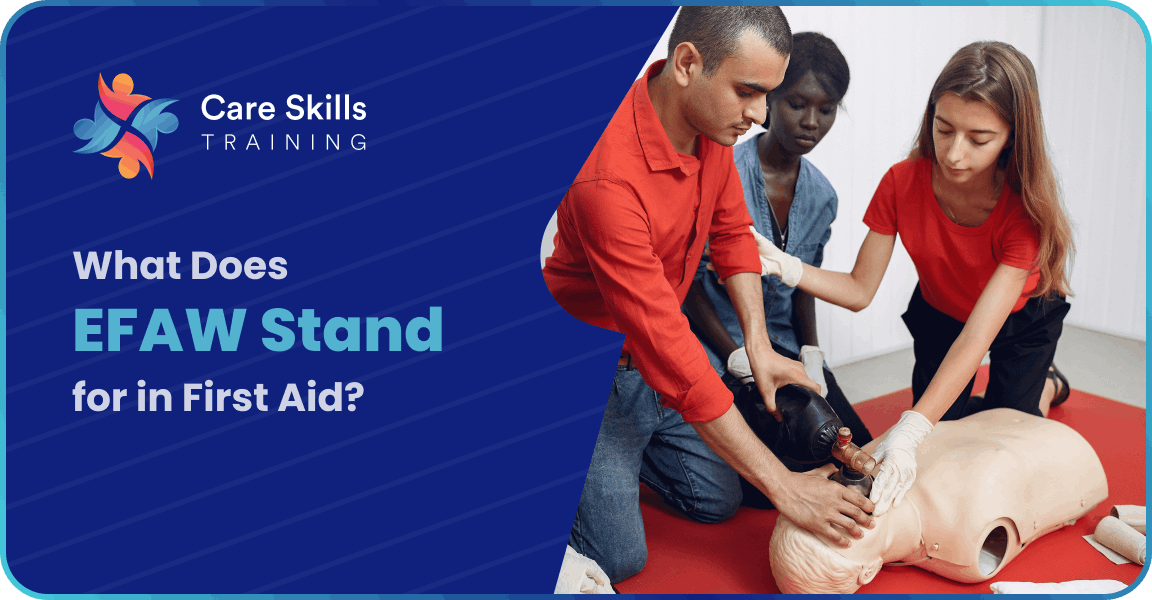
UK employers generally rely on two recognised first aid qualifications when training employees, one is EFAW and the other is FAW.
So, what does EFAW stand for in first aid? EFAW stands for Emergency First Aid at Work (EFAW), which is a 1-day training in line with the Health and Safety Executive (HSE) guidelines for handling urgent and life-threatening situations in the workplace. It teaches critical skills such as CPR, managing choking, and treating severe bleeding.
In this blog, you will find what EFAW covers, how it’s different from FAW, EFAW certificate validity, and why it’s important for employers to provide first aid courses to employees.
What is first aid and who is a first aider?

First aid is basically helping someone quickly if they’re hurt, sick, or injured. This care is usually provided by someone trained in first aid. First aid and emergency care have a significant impact when someone needs immediate medical attention. Usually, this emergency care is given when medical professionals are not immediately available.
A trained first aider is the person who provides first aid to the casualty. An individual must complete the EFAW or FAW training in order to become a workplace first aider in the UK.
Even without formal first aid training, help can be provided in emergencies. Someone who is not a trained first aider can perform hands-only CPR (chest compressions only).
What does EFAW stand for in first aid?
EFAW stands for Emergency First Aid at Work, and it is a 1-day training course. But with blended learning, this training can include both e-learning and face-to-face training. When choosing blended learning, employers must ensure that the online and face-to-face elements meet all required training standards.
It is the legal responsibility of employers to ensure that a trained first aider is always present in the workplace for emergencies. Completing the EFAW training will make the individual a certified workplace first aider. The skills from this training will help them properly carry out a first aiders duties and responsibilities.
What are the first aid qualifications?
The two primary first aid qualifications are:
- EFAW (Emergency First Aid at Work)
- FAW (First Aid at Work)
In the UK, first aiders must be certified in either of these two first aid qualifications. And this is the statement from the health and safety regulatory body, the Health and Safety Executive (HSE). Both options help gain recognised qualifications to become a first aider and to respond safely in urgent situations.


As an employer, you can not just put a first aid kit in your employees’ hands and expect them to take on the responsibilities of a first aider without training. You must provide them with either EFAW or FAW training from a trusted provider.
So, it’s the employer’s duty to provide you with the proper training to gain the qualifications for a first aider and provide first aid treatment in the workplace.
What is the difference between FAW and EFAW?
The topics covered in FAW and EFAW make all the difference. Typically, the FAW training covers more topics than the EFAW training, and the duration of both courses is also different. Plus, the UK’s Regulatory Qualification Framework (RQF) has also categorised both courses into different levels.
Here is a complete breakdown:
| EFAW (Emergency First Aid at Work) | FAW (First Aid at Work) |
| 1-day course (minimum 6 hours) | 3-day course (minimum 18 hours) |
| Focuses on emergency first aid only | Covers emergency and non-emergency situations |
| Covers CPR, AED use, choking, bleeding, shock, minor injuries | Covers all EFAW topics plus fractures, burns, poisoning, chest injuries, major illnesses |
| Suitable for low-risk workplaces | Required for higher-risk workplaces |
| Requalification every 3 years (1 day) | Requalification every 3 years (2 days) |
| Ideal for basic first aider roles | Ideal for lead first aider and higher responsibility roles |
| Meets HSE emergency first aid requirements | Meets full HSE first aid provision requirement |
When someone completes either of these two courses, they will be certified as a first aider. So, it’s important to choose the proper training provider.
What is an emergency first aid at work course?
The Emergency First Aid at Work (EFAW) is a training designed in line with the Health and Safety Executive (HSE) guidance that helps a first aider to quickly respond in life-threatening emergencies at the workplace. This 1-day training course includes a six-hour session, assessment, and an opportunity to practice the skills.
Upon completion of this EFAW course, a first aider would be able to:
- Understand the responsibilities of a first aider
- Learn to prevent cross infection
- Keep a record of the incidents
- Properly use the first aid kits
- Remain calm in critical situations
- Help an unconscious casualty
- Perform CPR and use an automated external defibrillator (AED)
- Help those who are choking, bleeding, wounded or having a seizure
- Treat minor injuries, such as small cuts, bruises, and minor burns.
This course is more suitable for low-risk working environments, such as corporate offices, small organisations, etc.
What is a First Aid at Work course?
The First Aid at Work course is also designed in line with the Health and Safety Executive (HSE) guidance. All the topics are also included in this FAW course. However, it also covers a broader range of specific injuries and illnesses.
This more extensive three-day FAW course includes 18 hours of training sessions. According to the HSE, upon completion of this FAW course, an individual will be able to carry out all the skills covered in the EFAW and other additional skills, such as:
- Providing first aid to
- Bone injury
- Muscle and joint injury
- Spinal injury
- Chest injury
- Burns and scalds
- Eye injury
- Sudden poisoning
- Anaphylactic shock
- Identifying major illnesses such as heart attack, stroke, epilepsy, asthma, diabetes, and helping them with proper first aid
This course is more suitable for high-risk working environments, such as construction sites, factories, warehouses, etc.
Why is first aid training important?
The skills gained from first aid training come in handy in the workplace and in everyday medical emergencies. A first aider can provide first aid in real-life emergencies when the medical professionals are not present.
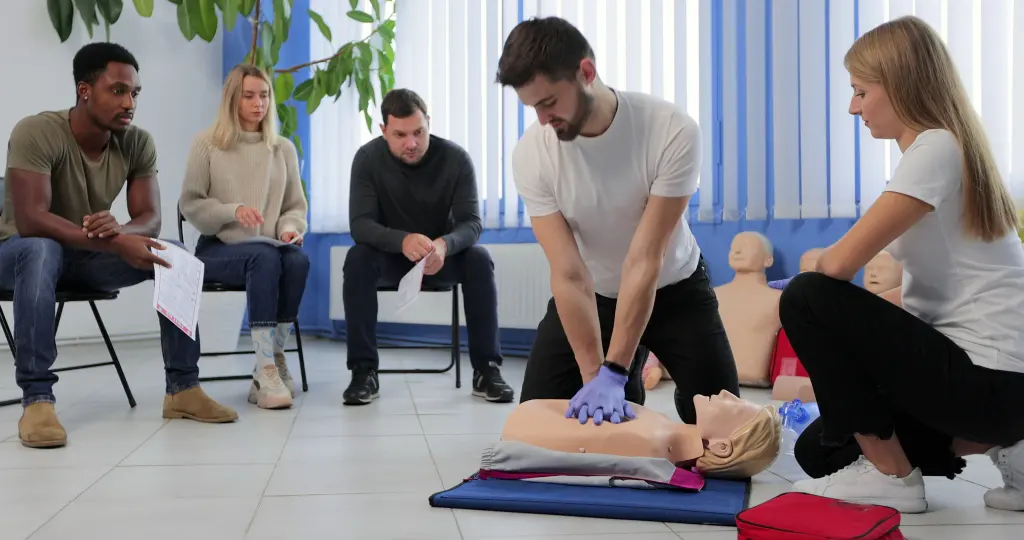
So, the undeniable benefits of first aid training are something to be discussed in detail. Let’s take a look:
Ready to respond in real-life emergencies
The first aid training prepares an individual for real-life emergencies. So, what are real-life emergencies?
Imagine that at a bus stop, somebody collapses, or somebody sprains their ankle in the middle of hiking, or somebody fainted in the middle of the workplace, or somebody is choking in the middle of a family dinner. All of these are real-life crisis situations.
The simple yet effective skills gained from the first aid training can have a huge impact in emergency situations, such as choking, bleeding, chest injury, anaphylactic shock and much more.
Building confidence in emergency situations
In stressful emergency medical situations, it’s important to keep calm. The first aid training gives confidence to handle emergencies with ease. So, when someone knows the step-by-step process of what to do in emergency situations, their confidence will boost naturally.
Support others
Providing support in medical emergencies is another goal of the first aid training. It takes courage, structured training and mental preparedness to provide first aid, and the first aid training covers all these.
Meeting workplace safety and legal requirements
Depending on the size or risk level of an organisation, first aid training for one or more employees can be a legal requirement. If your first aid needs assessment, you must ensure that staff receive appropriate first aid training to create a safer working environment.
Personal and professional development
Those who complete the first aid training become more confident in their role as a first aider. Quickly responding in emergencies showcases their dedication, which is beneficial for their continuous development.
How long does a first aid course take to complete?
The duration of first aid courses is different depending on the topics they cover. In the UK, the most demanded courses in the first aid category are EFAW training, FAW training, Paediatric First Aid Training and First Aid Requalification training.
And here is how long it takes to complete these courses:
- Emergency First Aid at Work (EFAW) is a 1-day training course (6 hours)
- First Aid at Work (FAW) is a 3-day training course (18 hours)
- Paediatric First Aid takes 1-2 days
- First aid refresher course (EFAW/FAW) takes 2 days to complete
How long do first aid certificates last in the UK?
Every first aid certificate is valid for 3 years in the UK. So, the certificate validity of Emergency First Aid at Work (EFAW), First Aid at Work (FAW), Paediatric First Aid, or Mental Health First Aid is the same as 3 years.
That’s why taking a requalification course every 3 years is essential. When a first aider continues to practice without completing the requalification course, they are no longer competent under the Health and Safety Executive (HSE). For this reason, employers must provide them with first aid requalification courses.
So, the question arises, can a first aider provide first aid without a valid certificate? In severe emergency situations, a first aider can provide first aid as a bystander. However, it’s recommended to complete the requalification course as soon as the first aid certificate expires.
How many first aiders do you need at work?
The number of required first aiders in a workplace varies depending on the risk level of the workplace and the number of employees. To answer the most common question of how many first aiders are needed in a workplace, let’s take a look at the table below:
| Workplace Risk Level | Number of Employees | Suggested Number of First Aiders |
| Low Risk e.g. retail shops, museums, community centres, offices, call centres | Up to 50 | 1 appointed person |
| 50 to 100 | 1 first aider | |
| Over 100 | One additional first aider for every 100 employees | |
| Medium Risk e.g. commercial kitchens, transport and logistics, assembly work, warehousing, food processing, light engineering | Up to 20 | 1 appointed person |
| 20 to 100 | 1 first aider for every 50 employees | |
| Over 100 | One additional first aider for every 50 employees | |
| High Risk e.g. manufacturing, construction, offshore oil & gas, construction site, waste management and recycling, transport and storage | Up to 5 | 1 appointed person |
| 5 to 50 | 1 first aider for every 50 employees | |
| Over 100 | 1 additional first aider for every 50 employees |


FAQ
Is it a legal requirement to have a first aider?
Not always. But the employers must provide adequate and appropriate first aid provision. It doesn’t always mean having a trained first aider in the workplace. A first aid needs assessment in order to find if a first aider is necessary for their workplace or not.
Can a registered nurse be a first aider?
Yes, a nurse can act as a first aider, but only if they’re a registered nurse with the NMC. That means if you’re registered, you can do first-aid duties even without a separate first aid certificate.
What are the 3 ps in first aid?
The 3 ps is a simple way to effectively respond in emergency situations, and it means:
✅ Preserve life
✅ Prevent further injury
✅ Promote recovery
Is an emergency first aider the same as an appointed person?
No, an emergency first aider and an appointed person are similar. An emergency first aider is a trained person responsible for providing first aid in emergency situations. On the other hand, an appointed person is responsible for the first aid arrangements.
Conclusion
In the UK, employers can choose from two types of first aid courses to train their employees. These two types of first aid courses are EFAW and FAW.
So, it is important to understand what does EFAW stand for in first aid. The full form of EFAW is Emergency First Aid at Work. This training makes an individual a certified first aider who can help people in medical emergencies until professionals arrive.
After completion of this EFAW training course, an individual can perform CPR, manage choking and treat severe bleeding confidently.




Level 3 Safeguarding Children and Vulnerable Adults
4.94.9Original price was: £119.00.£29.99Current price is: £29.99.
4515 Students

4 Hours

Level 5 Designated Safeguarding Lead (DSL)
4.94.9Original price was: £199.00.£49.99Current price is: £49.99.
4263 Students
7 Hours

3456 Students
17 Hours










0 responses on "What Does EFAW Stand for in First Aid?"