


Our Most Popular Categories
Trending
Health and Social Care
First Aid
Care Certificate
Food Hygiene
Mental Health
Safeguarding
Health and Safety
Animal Care & Training
Business Essentials
Career Bundles
Other Courses

- Accredited Dog First Aid, CPR and Grooming
- Pet Nutrition Diploma
- Pet First Aid and CPR Certification
- Pet Care and Psychology Diploma
- Learn to Launch and Grow a Pet Business
- Cat First Aid, CPR and Emergency Care
- Complete Dog Behaviour and Training
- Dog First Aid, CPR & Grooming + Safety for Pet Pros & Owners
- Care Certificate Course
- Mandatory Training For Care Staff and Care Workers
- Level 2 Safeguarding Children and Vulnerable Adults
- Care Planning and Record Keeping in Health and Social Care
- Family Support Worker Training
- Training For Care Workers (Complete Package)
- Care Certificate Standards (1 to 16) + Level 2 And 3 Diploma in Health and Social Care
- Mandatory Training for Care Home Staff Training
- Mandatory Training For Care Staff and Care Workers
- Mandatory Training for Care Home Staff Training
- Mandatory and Statutory Trainings For Adult Social Care
- Mandatory Training For Care Assistants
- Mandatory and Core Social Care Courses
- Mandatory Training For Agency Nurses
- Mandatory Training for General Practitioners
- Mandatory Training For Support Workers
- Personal Assistant Job Ready Programme
- Health and Safety Job Ready Programme
- Project Management Job Ready Programme
- Virtual Assistant Job Ready Programme
- Teaching Assistant Job Ready Programme
- Assistant Manager Job Ready Programme
- Healthcare Support Worker Job Ready Programme
- Office Manager Job Ready Programme
- Problem Solving in Leadership: Lead Your Team to Success
- Surviving Office Politics: Mastering Workplace Relationships
- Business Fundamentals Course Online
- Unconscious Bias Training
- ISO 9001 Quality Management System Training (Clauses 6-10)
- ISO 9001 Quality Management System Training (Clauses 1–5)
- Emotional Intelligence Training
- Personal Assistant Job Ready Programme
- Health and Safety Job Ready Programme
- Project Management Job Ready Programme
- Teaching Assistant Job Ready Programme
- Assistant Manager Job Ready Programme
- Healthcare Support Worker Job Ready Programme
- Office Manager Job Ready Programme
- Designated Safeguarding Lead (DSL) Job Ready Programme
- Level 3 Safeguarding Children and Vulnerable Adults
- Level 5 Designated Safeguarding Lead (DSL)
- Safeguarding Level 4 Training
- Designated Safeguarding Lead (Level 3 DSL Training)
- Safeguarding Adults Level 3
- Level 2 Safeguarding Children and Vulnerable Adults
- Level 3 Diploma in Nursing Assistant Training
- Safeguarding Adults Training Level 3
- Diabetes Awareness Training
- Baby Massage Training
- Employment Law Training
- Learn to Launch and Grow a Pet Business
- Complete Dog Behaviour and Training
- Dog First Aid, CPR & Grooming + Safety for Pet Pros & Owners
- Drugs and Alcohol Awareness Training
- Dog Care, Dog Grooming, and Dog First Aid Course Online
- Care Certificate Standards 1-16 (The Complete Bundle)
- Training For Care Workers (Complete Package)
- Care Certificate Standards (1 to 16) + Level 2 And 3 Diploma in Health and Social Care
- Mandatory Training for Care Home Staff Training
- First Aid Essentials 1 to 6 Bundle
- Leadership and Management Courses
- Mandatory and Statutory Trainings For Adult Social Care
- Level 3 Admin PA and Secretarial Diploma Bundle
- Yearly Subscription: Unlimited Access to 300+ Courses
- Level 3 Safeguarding Children and Vulnerable Adults
- Level 5 Designated Safeguarding Lead (DSL)
- Care Certificate Course
- Safeguarding Level 4 Training
- Health and Social Care Level 3 Diploma
- Accredited Dog First Aid, CPR and Grooming
- Trauma-Informed Care Training



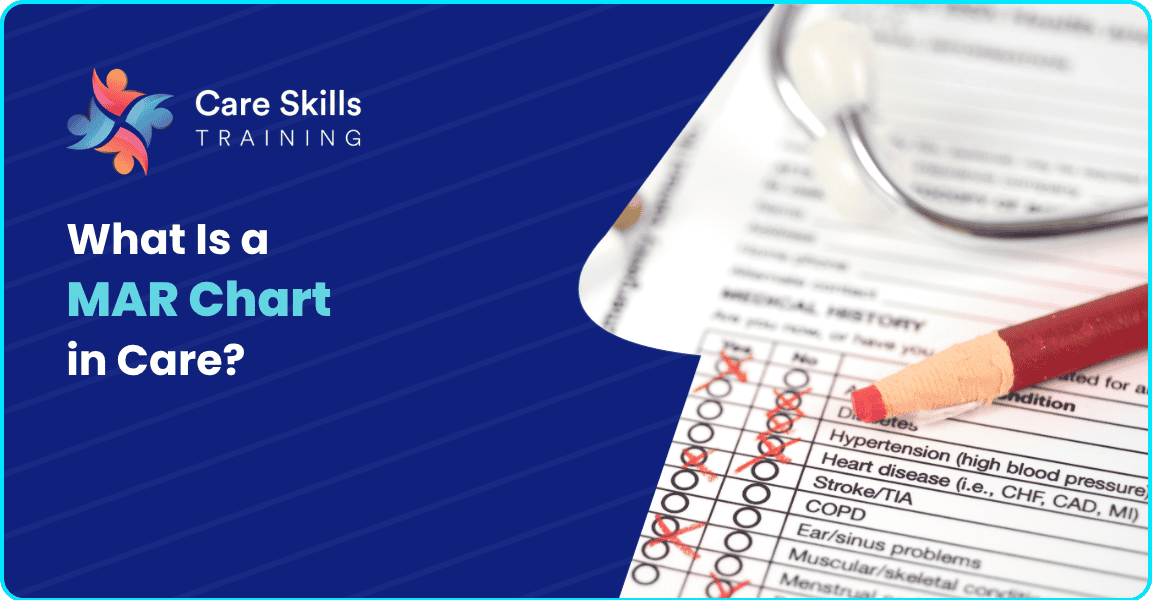
A missed signature on a medication round can look like a small slip. But in care work, that tiny gap can be the difference between a safe, traceable dose and a dangerous unknown. It’s usually the first thing new care staff learn to take seriously.
So, what is a MAR chart in care? A Medication Administration Record (MAR) chart is the legal document staff use to record every dose of medication given to someone receiving care. It shows what was given, when, by whom, and confirms nothing was missed, duplicated, or given in error.
It sounds like paperwork, but MAR charts sit right at the centre of safe, compliant care. Get them right and you protect the people you support every single day. Get them wrong and you risk real harm, safeguarding concerns, and serious findings at your next CQC inspection.
What Is a MAR Chart in Care?
MAR stands for Medication Administration Record. It’s a legal, auditable record that tracks every prescribed medicine a person receives, whether that’s tablets, liquids, patches, injections, or topical creams. Some services still call it a MAR sheet or a medication chart, but they all mean the same thing.

Every care home, domiciliary care agency, and supported living service uses one in some form. Pharmacies often supply a printed MAR chart alongside blister-packed medication, though many providers now use electronic versions instead. Either way, the purpose stays the same. It proves medicine was given safely, correctly, and on time.
The concept isn’t unique to the UK, but the format and expectations here are shaped heavily by NICE and CQC guidance. That’s part of why MAR charts look fairly consistent across different providers, even though the exact layout can vary between paper suppliers and eMAR software.
It’s also worth understanding what a MAR chart isn’t. It’s not a prescription, and it doesn’t replace the GP’s instructions or the pharmacy label. It’s the working record that sits alongside those documents, translating the prescription into a practical, day-to-day log that staff actually complete.


What Does a MAR Chart Actually Record?
A MAR chart holds more detail than most people expect. Every entry needs to answer the same basic questions, no matter which provider or format is used. Typically, a MAR chart records:
- The resident’s full name, date of birth, and any known allergies.
- The medication name, strength, and form.
- The prescribed dose, the time it’s due, and the route it’s given by.
- The start and stop dates for each medicine.
- The signature or initials of whoever administered the dose.
- A code explaining why a dose wasn’t given, if it wasn’t.
That level of detail matters because a MAR chart isn’t just a checklist. It’s evidence. If a resident’s health changes, or a family raises a concern, this is the document that shows exactly what happened and when, which makes it one of the most closely reviewed records in any care setting.
Most charts are laid out as a grid, with medicines listed down one side and dates across the top. Each box represents a single scheduled dose, which staff sign or code at the time it’s due. This structure makes it easy to spot a missed entry at a glance, which is exactly why gaps stand out so clearly during an audit.
A good MAR chart also captures context beyond the basic grid. Many include space on the reverse for PRN medication details, body maps for topical creams, or notes on why a dose was adjusted. This extra detail is often what separates a chart that simply exists from one that genuinely supports safe care.
Why Are MAR Charts a CQC Compliance Requirement?
MAR charts aren’t just good practice, they’re a legal expectation. Under Regulation 12 of the Health and Social Care Act 2008, providers must ensure the proper and safe management of medicines. Accurate MAR charts are how that duty gets demonstrated in practice, day after day.
During inspections, CQC assessors routinely sample MAR charts to check for gaps, unexplained codes, and inconsistent signing patterns. They’re looking for evidence that medicines are managed safely, not just that a form has been filled in. Patterns of missed entries tend to raise questions fast, even when no actual harm occurred.
Inspectors will often ask staff to explain a specific entry on the spot, which is why understanding the chart matters as much as completing it. A care worker who can confidently talk through why a code was used, and what action followed, tends to reassure an inspector far more than a perfectly neat but unexplained signature.
Poor MAR chart practice doesn’t just risk a bad inspection outcome. Unexplained gaps can trigger safeguarding referrals, internal investigations, and disciplinary action. For providers, it can affect the overall rating of the service, sometimes dragging a rating from good to requires improvement almost single-handedly. For individual staff, it can affect their standing and their job.
Who Is Responsible for Completing a MAR Chart?
Any trained care worker administering medication is responsible for completing the MAR chart at the time of giving it, not later in the shift. Recording it straight away avoids confusion, especially on busy rounds where several residents are due medication close together.
Registered managers and senior carers carry the wider responsibility. They oversee competency checks, spot-check MAR charts regularly, and make sure new staff are only administering medication once they’ve completed proper medication administration training and been signed off as competent to do so.
Competency isn’t usually a one-off event either. Most providers run periodic reassessments, particularly after any error or near miss, and new staff are typically shadowed for a set period before they’re allowed to administer medication and sign a MAR chart unsupervised.

Which medication should be recorded on a MAR chart?
Every prescribed medicine goes on the MAR chart, including regular tablets, liquids, insulin, patches, creams, and eye or ear drops. PRN medication, meaning medicine given only when needed, also belongs here, recorded only once it’s actually been administered rather than in advance.
Medication a person takes independently, without staff support, usually sits outside the MAR chart and gets noted in the care plan instead. The general rule is simple. If staff are involved in giving, prompting, or supervising a dose, it needs to be recorded on the chart.
Controlled drugs need extra care on top of the standard MAR entry. These usually require a second, separate register, along with a witnessed signature from a trained colleague, since the risks around misuse and diversion are much higher than with ordinary medication.
Common MAR Chart Errors and How to Avoid Them
Most MAR chart problems come down to a handful of repeat mistakes rather than anything complicated. The most common ones to watch for include:
- Missed signatures, usually caused by rushing or being interrupted mid-round.
- Blank boxes left instead of a proper non-administration code.
- Illegible handwriting that makes an entry impossible to verify later.
- Corrections made with correction fluid instead of a single line and signature.
- Codes used inconsistently between staff on different shifts.
- Recording a dose before it’s actually been given, rather than after.
The fix for most of these is discipline rather than extra paperwork. Sign the chart the moment a dose is given, use the agreed code every time a dose is withheld, and correct mistakes properly. A single line through the error, followed by the correct entry, a signature, and a date, keeps the record trustworthy.
Many providers now build in a second layer of protection too, such as a daily audit by a senior carer or a weekly check by the registered manager. Catching an error within a day or two makes it far easier to correct and explain, rather than discovering a gap weeks later with no one able to recall what actually happened.
MAR Charts vs EMAR Chart
A paper MAR chart is exactly what it sounds like, a printed sheet completed by hand at the point of administration. An eMAR, or electronic MAR chart, does the same job digitally, usually through a tablet or handheld device at the point of care. Both aim to do the same job, but they behave quite differently in practice.
| Feature | Paper MAR Chart | Electronic MAR (eMAR) |
| Error checking | Relies on staff spotting mistakes manually | Automatically flags missed or late doses |
| Oversight | Needs a physical audit by a manager | Gives real-time visibility across the service |
| Handwriting risk | Entries can be illegible or ambiguous | Entries are always typed and time-stamped |
| Reliability | Not dependent on signal, power, or devices | Can be affected by technical faults or outages |
| Setup cost | Low, usually supplied by the pharmacy | Higher, requires software and staff training |
| Audit trail | Manual, can be time-consuming to review | Searchable and exportable at any time |
Many providers are shifting toward eMAR because it reduces transcription errors and gives managers instant oversight across the whole service. Paper charts haven’t disappeared though, and plenty of smaller domiciliary providers still use them well, provided the discipline around signing stays consistent.
Neither format guarantees safe practice on its own. An eMAR system still depends on staff logging in and recording accurately at the right time, and a paper chart can be kept flawlessly with the right habits. The format supports good practice, but it doesn’t replace it.
MAR Chart Codes
Codes exist so staff can record exactly why a dose wasn’t given, without writing a full explanation every time. Codes vary slightly between providers, but common examples include:
- R for the resident refusing the medication.
- H for the resident being in hospital.
- NA for the medication not being available.
- D for the medicine being discontinued.
- W for the dose being withheld on clinical or professional advice.
Every provider should have an agreed code key, usually printed directly on the chart itself, so there’s no ambiguity between shifts or staff members. NICE guidance recommends that codes are used consistently and that any refusal or omission is followed up rather than simply logged and left.
A code should never be the end of the story on its own. If a resident refuses medication several times in a row, that pattern needs escalating, whether that’s a conversation with the GP, a review of the medicine itself, or a wider look at why the refusal is happening in the first place.
MAR Charts in Domiciliary Care
Domiciliary care adds a layer of complexity that care homes don’t usually face. Staff visit residents in their own homes, often alone, which means the MAR chart has to travel with the medication and stay accurate without a second pair of eyes checking it during the visit.
Because of this, domiciliary carers often work with a MAR chart kept in the person’s home rather than centrally. Clear handover between visiting staff becomes essential, particularly for PRN medication, since there’s no shared office board to flag that a dose has already been given that day.
Many domiciliary agencies now use mobile eMAR apps for exactly this reason. Logging a dose the moment it’s given, from the person’s own home, gives the office real-time confirmation that the visit happened and the medication was administered correctly, rather than waiting for paperwork to be returned days later.
MAR Charts in Care Homes
In a care home, MAR charts usually sit within a wider medication round system, often supported by a trolley, locked cabinet, or electronic device. Staff move resident to resident, checking each MAR chart against the medication being given before recording it, which builds in a natural double-check.
Care homes also tend to have more oversight built in. Senior carers or nurses often countersign controlled drugs, and registered managers regularly audit MAR charts as part of routine checks. This layered accountability is part of what CQC inspectors look for when reviewing medicines management across a service.
Larger homes sometimes split medication rounds by floor or unit, particularly where residents have complex needs such as dementia or nursing care. Each round tends to carry its own set of MAR charts, which makes it easier to keep the record close to the resident it belongs to.
FAQ
Do all medication errors need to be reported to CQC?
Not every minor error requires a direct CQC report, but providers must have a clear process for recording, investigating, and learning from all medication errors internally. Serious incidents, especially those causing harm, typically do need to be reported as part of the provider’s safeguarding and notification duties.
Can a carer give medication without a MAR chart?
No. Medication should never be given without a MAR chart to record it against. Doing so removes the audit trail that proves the dose was correct, safe, and intended for that person, which puts both the resident and the member of staff at unnecessary risk
How long should a MAR chart be kept?
Completed MAR charts are usually kept for a minimum of seven years, in line with general care record retention practice, though individual provider policies and local authority requirements can extend this. It’s always worth checking your own service’s medicines policy for the exact retention perio
What are the 3 MAR checks?
Most providers train staff to check three times before signing. First, check the medication against the MAR chart when removing it from storage. Second, check it again immediately before giving it to the resident. Third, confirm and sign the chart straight after the dose has been given.
Final Thought
So, what is a MAR chart in care, at the end of the day? It’s not just paperwork. It’s a daily safeguard. It protects residents from missed or duplicated doses, protects staff by creating a clear record of what was done, and gives managers and inspectors confidence that medicines are handled properly.
Getting it right isn’t about perfect handwriting or ticking boxes quickly. It’s about treating each entry as part of someone’s care, not just a task to finish before moving to the next resident. That mindset is what actually keeps people safe, far more than the paperwork itself.




Level 3 Safeguarding Children and Vulnerable Adults
4.94.9Original price was: £119.00.£29.99Current price is: £29.99.
4406 Students

4 Hours

Level 5 Designated Safeguarding Lead (DSL)
4.94.9Original price was: £199.00.£49.99Current price is: £49.99.
4198 Students
7 Hours
-
3409 Students
17 Hours







0 responses on "What Is a MAR Chart in Care? Everything Care Staff Need to Know"