


Our Most Popular Categories
Trending
Health and Social Care
First Aid
Care Certificate
Food Hygiene
Mental Health
Safeguarding
Health and Safety
Animal Care & Training
Business Essentials
Career Bundles
Other Courses

- Accredited Dog First Aid, CPR and Grooming
- Pet Nutrition Diploma
- Pet First Aid and CPR Certification
- Pet Care and Psychology Diploma
- Learn to Launch and Grow a Pet Business
- Cat First Aid, CPR and Emergency Care
- Complete Dog Behaviour and Training
- Dog First Aid, CPR & Grooming + Safety for Pet Pros & Owners
- Care Certificate Course
- Mandatory Training For Care Staff and Care Workers
- Level 2 Safeguarding Children and Vulnerable Adults
- Care Planning and Record Keeping in Health and Social Care
- Family Support Worker Training
- Training For Care Workers (Complete Package)
- Care Certificate Standards (1 to 16) + Level 2 And 3 Diploma in Health and Social Care
- Mandatory Training for Care Home Staff Training
- Mandatory Training For Care Staff and Care Workers
- Mandatory Training for Care Home Staff Training
- Mandatory and Statutory Trainings For Adult Social Care
- Mandatory Training For Care Assistants
- Mandatory and Core Social Care Courses
- Mandatory Training For Agency Nurses
- Mandatory Training for General Practitioners
- Mandatory Training For Support Workers
- Personal Assistant Job Ready Programme
- Health and Safety Job Ready Programme
- Project Management Job Ready Programme
- Virtual Assistant Job Ready Programme
- Teaching Assistant Job Ready Programme
- Assistant Manager Job Ready Programme
- Healthcare Support Worker Job Ready Programme
- Office Manager Job Ready Programme
- Problem Solving in Leadership: Lead Your Team to Success
- Surviving Office Politics: Mastering Workplace Relationships
- Business Fundamentals Course Online
- Unconscious Bias Training
- ISO 9001 Quality Management System Training (Clauses 6-10)
- ISO 9001 Quality Management System Training (Clauses 1–5)
- Emotional Intelligence Training
- Personal Assistant Job Ready Programme
- Health and Safety Job Ready Programme
- Project Management Job Ready Programme
- Teaching Assistant Job Ready Programme
- Assistant Manager Job Ready Programme
- Healthcare Support Worker Job Ready Programme
- Office Manager Job Ready Programme
- Designated Safeguarding Lead (DSL) Job Ready Programme
- Level 3 Safeguarding Children and Vulnerable Adults
- Level 5 Designated Safeguarding Lead (DSL)
- Safeguarding Level 4 Training
- Designated Safeguarding Lead (Level 3 DSL Training)
- Safeguarding Adults Level 3
- Level 2 Safeguarding Children and Vulnerable Adults
- Level 3 Diploma in Nursing Assistant Training
- Safeguarding Adults Training Level 3
- Diabetes Awareness Training
- Baby Massage Training
- Employment Law Training
- Learn to Launch and Grow a Pet Business
- Complete Dog Behaviour and Training
- Dog First Aid, CPR & Grooming + Safety for Pet Pros & Owners
- Drugs and Alcohol Awareness Training
- Dog Care, Dog Grooming, and Dog First Aid Course Online
- Care Certificate Standards 1-16 (The Complete Bundle)
- Training For Care Workers (Complete Package)
- Care Certificate Standards (1 to 16) + Level 2 And 3 Diploma in Health and Social Care
- Mandatory Training for Care Home Staff Training
- First Aid Essentials 1 to 6 Bundle
- Leadership and Management Courses
- Mandatory and Statutory Trainings For Adult Social Care
- Level 3 Admin PA and Secretarial Diploma Bundle
- Yearly Subscription: Unlimited Access to 300+ Courses
- Level 3 Safeguarding Children and Vulnerable Adults
- Level 5 Designated Safeguarding Lead (DSL)
- Care Certificate Course
- Safeguarding Level 4 Training
- Health and Social Care Level 3 Diploma
- Accredited Dog First Aid, CPR and Grooming
- Trauma-Informed Care Training



Working with someone whose behaviour puts them or others at risk can leave even experienced care staff feeling unsure. You want to help. But without a clear framework, it’s easy to fall back on reacting in the moment. That’s not the same as understanding what’s really going on for the person in front of you.
So, what is a positive behaviour support plan? It’s a personalised, written plan used across care settings. It helps staff understand why someone behaves the way they do. Then it guides them to respond in ways that protect the person’s dignity. The focus shifts from controlling behaviour to understanding it. That shift changes how a care team works, day to day.
This guide walks through what a PBS plan contains. It covers how one gets built, step by step, and where it fits alongside your organisation’s wider policies. Along the way, we’ll look at the benefits these plans bring and how they compare to older, more restrictive methods.
We’ll also cover who usually gets involved in building one, and the difference between a PBS plan and a PBS policy. By the end, you’ll have a clear picture of how these plans work in practice.
What Is a Positive Behaviour Support Plan?

A positive behaviour support plan is a structured plan built around one person. It sets out how a care team should support someone whose behaviour might be described as challenging. PBS doesn’t treat that behaviour as a problem to remove. Instead, it treats it as a form of communication. It’s something the person is expressing because they can’t yet find another way to say it.
Often, the person can’t easily put their needs into words. So they express them through action instead. That might mean shouting, withdrawing, or physically resisting support. The plan brings together background information, an assessment of what triggers certain behaviours, and a set of agreed strategies. Staff use these to reduce distress before it builds, and to respond safely when it does happen.
This mirrors the thinking behind wider person centred care across the sector. The person’s history, preferences, and pace always come first. Nobody gets a generic template applied to them regardless of their own story.
It’s worth being clear about what a PBS plan is not, too. It isn’t a behaviour contract. It isn’t a list of rules for the person to follow, and it isn’t a punishment system built around consequences. It’s a support tool for the staff around that person. It guides how they respond, so the individual feels understood rather than managed.


Objectives of the Framework
PBS plans exist to achieve a few specific things. These goals explain why the approach looks so different from older, more restrictive ways of managing behaviour. They also explain why so many services have moved towards it.
- Improve the person’s overall quality of life, not just reduce incidents
- Understand the function behind behaviour, rather than suppress the behaviour itself
- Reduce reliance on restrictive practices such as physical restraint
- Build consistency across everyone supporting the person, from staff to family
- Create predictable, safe environments that lower the chance of distress
Why Behaviour Support Plans Matter in Care Settings?
Without a plan, care workers are often left guessing. Different staff might respond to the same behaviour in different ways. That inconsistency confuses the person being supported. It can genuinely make things worse over time. A PBS plan brings consistency, so everyone knows what to do and why, shift after shift.
A plan also protects people from unnecessary restriction. Regulators such as the CQC expect providers to show how they support people well. That means not defaulting to restraint or containment as a first response. A well-written plan proves that a service understands the person behind the behaviour, not just the incident itself.
There’s a wellbeing side to this too, and it matters just as much as the compliance angle. Staff might see distress driven by pain, sensory overload, or an unmet need. Once they understand the cause, they can treat it directly. That beats managing the symptom in front of them. It tends to mean fewer incidents and calmer shifts for everyone involved, including the staff themselves.
Staff confidence often improves too. An agreed plan takes the guesswork out of a difficult moment. That reduces stress for the worker as well as the person they’re supporting. Over time, that confidence can even show up in staff retention. Fewer people burn out responding to the same unpredictable situations with no real support behind them.
Who Might Need a Positive Behaviour Support Plan?
PBS plans are most common in services supporting people with learning disabilities, autism, dementia, or complex mental health needs. Some children’s and educational settings use them too. This tends to happen where a child’s needs go beyond a standard behaviour policy. The core principles stay much the same across each of these settings.
Someone might need a plan if their behaviour puts themselves or others at risk. It might also be needed if the behaviour limits their access to everyday life, such as going out or joining in with others. It’s common too when staff simply can’t work out what’s triggering someone’s distress, even after trying a few different approaches already.
Needing a PBS plan isn’t a sign that someone is “difficult.” Usually it just means their needs haven’t been fully understood yet. Building that understanding is exactly what the process is designed to do.
For care workers supporting autistic adults, understanding sensory needs and communication differences makes a real difference here. Our guide to autism activities for adults goes into more depth on this side of things.
Age matters less than you might think when deciding whether someone needs a plan. What matters more is whether the current approach is working. Staff repeating the same reactive response, week after week, with no improvement, is usually a clear sign. A proper PBS plan will help far more than another informal chat about “managing” the behaviour.
What Is a Positive Behaviour Support Policy?
It’s easy to confuse a PBS plan with a PBS policy, but they work at different levels. The policy is the framework a whole organisation adopts. It governs how and when individual PBS plans should be used across every team the provider runs. The plan itself is built for one specific person, based on their own history and needs.
A strong policy sets out staff training requirements. It explains how functional assessments get carried out, and when a plan needs review. It also says who signs off on reactive strategies before staff are allowed to use them. Most policies reference legal frameworks such as the Mental Capacity Act too, so staff understand the boundaries around consent from the outset.
A clear policy stops PBS becoming inconsistent between teams or shifts. That inconsistency is one of the most common reasons plans fail in practice. For a wider look at how policies shape day-to-day practice, our guide on health and social care policies and procedures covers this well.
New staff should be able to read the policy and understand what’s expected of them straight away. This matters before they ever meet the person they’ll be supporting. When a policy leaves too much open to interpretation, individual plans tend to drift. Often nobody notices until a review flags it.
What’s Included in a PBS Plan
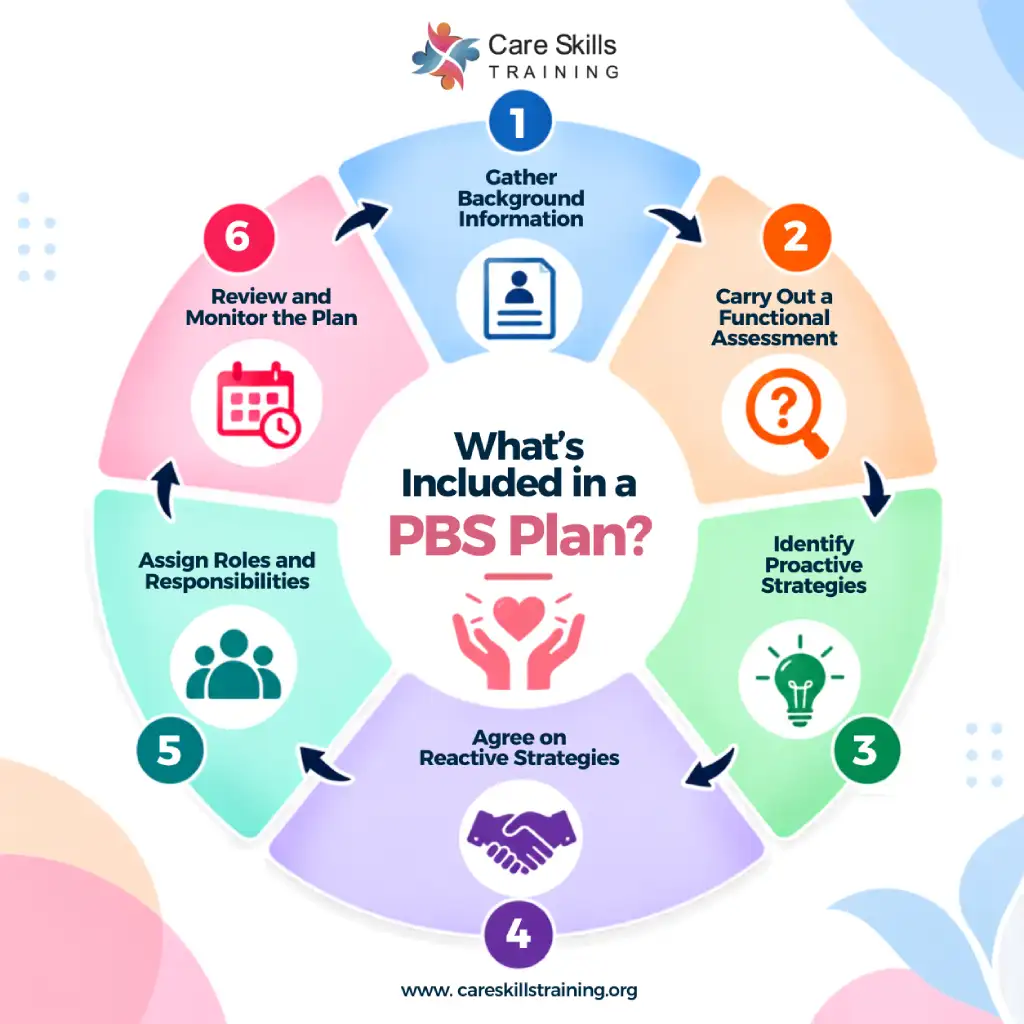
A PBS plan isn’t something you fill in once and forget about. It builds gradually, from a first conversation through to a working, living document. Here’s how that typically works in practice.
Step 1: Gather Background Information
The starting point is understanding the person, not their behaviour. This means collecting information on their history, communication style, likes, dislikes, and health conditions. It also means learning what a good day actually looks like for them. Family members and existing care records are often the best source here. They hold years of context a new plan simply can’t capture alone.
Step 2: Carry Out a Functional Assessment
This step tries to answer one question. Why does the behaviour happen? The team looks closely at what comes before it, and what happens afterwards. They build a picture over days or weeks, rather than guessing from a single incident.
Common functions include escaping an uncomfortable situation, seeking attention, seeking sensory input, or communicating pain that hasn’t been picked up elsewhere. Getting this step right shapes everything that follows.
Some teams use simple observation charts for this. They log what happened just before and after each incident. Patterns often only become obvious once you see several logged side by side. A single incident rarely tells the full story on its own.
Step 3: Identify Proactive Strategies
Once the triggers are clearer, the team can plan changes that reduce distress before it even starts. This might include:
- Adjusting the environment, such as reducing noise or clutter
- Building predictable routines the person can rely on
- Teaching alternative ways to communicate needs
- Offering more choice and control over daily activities
- Addressing unmet sensory or physical health needs
Step 4: Agree on Reactive Strategies
Even with strong proactive work, distress can still happen sometimes. It’s worth planning for this honestly, rather than hoping it won’t occur. Reactive strategies set out exactly how staff should respond if it does. They always use the least restrictive approach possible for that person. These steps need agreement in advance. Nobody should have to improvise during a tense, fast-moving situation.
Step 5: Assign Roles and Responsibilities
Everyone supporting the person needs to know their part clearly. That might mean naming a lead worker. It might mean agreeing on how the family are kept informed as the plan develops. Someone also needs the authority to update the plan when something clearly isn’t working.
Step 6: Review and Monitor the Plan
A plan should never sit still on a shelf. Regular review, often monthly at first, helps the team see whether strategies are actually working. The plan changes as the person’s needs shift, or as new patterns show up in their behaviour over time.
If the person also has a wider care plan in place, it helps to understand how the two connect. Our guide on what a care plan looks like in a care home explains this clearly.
Understanding the Function of Behaviour
At the heart of PBS sits one core idea. All behaviour serves a purpose, even when that purpose isn’t obvious straight away. Someone might behave a certain way because they’re in pain, or overwhelmed by their surroundings. They might be unable to express a need in words, or trying to gain some control over a situation that feels unpredictable.
This is why a functional assessment matters so much. It’s worth taking the time to get it right. Jumping straight to strategies, without understanding the “why,” often means treating the symptom rather than the cause. That rarely leads to lasting change. The same behaviour can resurface later, just in a slightly different form.
Capacity and consent matter here too. This is especially true for people who may lack capacity to understand certain decisions about their care. Our guide to the Mental Capacity Act and Deprivation of Liberty Safeguards explores this in more depth.
It’s also worth remembering that the function of a behaviour can shift over time. Something that started as a way to avoid a stressful task might, months later, become a habit tied to attention instead. This is exactly why review matters. Treating the first assessment as fixed forever rarely serves the person well.
PBS vs Restrictive Practice
It helps to see how positive behaviour support actually differs from older, more restrictive ways of managing behaviour. Some services still lean on both approaches without a clear reason why. The table below sets out some of the key contrasts care teams should know.
| Approach | Focus | Typical Methods | Long Term Impact |
| Positive Behaviour Support | Understanding the cause of behaviour | Functional assessment, proactive strategies, skill building | Better quality of life, fewer incidents over time |
| Restrictive Practice | Controlling the behaviour itself | Physical restraint, seclusion, blanket restrictions | Short-term compliance, risk of distress and lost trust |
Choosing PBS over restrictive methods isn’t just a philosophical preference. It has practical consequences too. Reducing restrictive practice is increasingly a regulatory expectation across the sector.
Services that lean on restraint often see behaviours return, or even worsen, once the pressure lifts. The underlying cause simply hasn’t been addressed. For more on where the line sits legally, our guide to restrictive practice in care is worth a read.
None of this means restrictive measures are never appropriate. In genuine emergencies, keeping someone safe has to come first. The difference with PBS is that restriction becomes a last resort. It’s written into the plan for rare situations, rather than the everyday default staff reach for out of habit.
Who’s Involved in Creating a Positive Behaviour Support Plan?
Building a PBS plan is rarely a one-person job. Trying to do it alone usually means missing something important. It draws on a mix of people, each bringing a different piece of the puzzle to the table.
- The individual themselves, wherever they’re able to contribute their own view
- Family members or advocates who understand their history best
- Frontline care or support workers who see day-to-day patterns first-hand
- Behaviour specialists or psychologists, particularly for more complex needs
- Speech and language therapists, where communication plays a central role
Care workers often carry out the daily work of putting a plan into action. That’s exactly why understanding your own safeguarding responsibilities matters just as much as understanding the plan itself. Our guide on safeguarding for care assistants covers this in more depth. The Skills for Care positive behavioural support hub is also a useful reference point for training standards across the wider sector.
Good communication between everyone on this list matters more than any single document. A plan written in isolation tends to miss things. This is especially true without input from the person’s family, or from the staff who see them every day.
What Are the Benefits of a Positive Behaviour Support (PBS) Plan?
When a PBS plan works well, the benefits go far beyond fewer difficult incidents on a shift log. They tend to ripple out across the whole care relationship, touching everyone connected to that person’s support.
- Fewer incidents of distress or crisis over time
- Reduced use of restrictive practices such as restraint
- Better quality of life and independence for the individual
- More confident, consistent staff who know how to respond
- Stronger trust between the person, their family, and the care team
- Clearer evidence of good practice for inspections and audits
These benefits build gradually, not overnight. It’s worth setting realistic expectations from the start. A plan that gets reviewed regularly and genuinely followed by everyone involved tends to keep improving. The team simply learns more over time about what actually works for that particular person.
Providers often notice a knock-on effect too. Families feel more confident raising concerns. Staff feel more supported in difficult moments. The overall culture of a service tends to shift towards understanding, rather than control. That cultural change is harder to measure than incident numbers, but it’s just as real.
Frequently Asked Questions
What’s the difference between a PBS plan and a care plan?
A care plan covers someone’s overall support needs, including health, daily living, and personal preferences. A PBS plan sits alongside it. It focuses specifically on understanding and responding to behaviours that challenge.
Is a PBS plan legally required?
No single law demands every service produce a PBS plan by name. But regulators expect services to show how they support people without relying on restrictive practices, which in practice usually means having one.
Can family members contribute to a PBS plan?
Yes, and their input is often invaluable. Family members frequently know the person’s history, triggers, and communication style better than anyone else on the team.
How many hours for a behaviour support plan?
There’s no fixed number of hours. It depends on how complex the person’s needs are. Building a thorough plan, including assessment, usually takes several weeks rather than a single sitting.
How much does a positive behaviour support plan cost?
Costs vary depending on whether specialist input, such as a behaviour analyst or psychologist, is needed. Many services build PBS planning into existing staff time, while more complex cases may need paid specialist assessment.
How often are behaviour support plans reviewed?
Most plans get reviewed monthly at first, then less often once strategies prove they’re working. Any big change in behaviour should trigger an earlier review, though.
Final Thought
So, what is a positive behaviour support plan? In short, it’s a personalised plan that helps care teams understand why someone behaves the way they do. It then guides them to respond with strategies built around that person, not a one-size-fits-all rulebook. It combines background information, a functional assessment, and clear proactive and reactive strategies into one living document.
A PBS plan isn’t about controlling someone’s behaviour. It’s about understanding the person behind it, and building support around what they actually need to feel safe and settled.
These plans change more than incident numbers. They build trust, protect dignity, and give care teams the confidence to respond with understanding rather than reaction.




Level 3 Safeguarding Children and Vulnerable Adults
4.94.9Original price was: £119.00.£29.99Current price is: £29.99.
4406 Students

4 Hours

Level 5 Designated Safeguarding Lead (DSL)
4.94.9Original price was: £199.00.£49.99Current price is: £49.99.
4197 Students
7 Hours
-
3409 Students
17 Hours





0 responses on "What Is a Positive Behaviour Support Plan?"