


Our Most Popular Categories
Trending
Health and Social Care
First Aid
Care Certificate
Food Hygiene
Mental Health
Safeguarding
Health and Safety
Animal Care & Training
Business Essentials
Career Bundles
Other Courses

- Accredited Dog First Aid, CPR and Grooming
- Pet Nutrition Diploma
- Pet First Aid and CPR Certification
- Pet Care and Psychology Diploma
- Learn to Launch and Grow a Pet Business
- Cat First Aid, CPR and Emergency Care
- Complete Dog Behaviour and Training
- Dog First Aid, CPR & Grooming + Safety for Pet Pros & Owners
- Care Certificate Course
- Mandatory Training For Care Staff and Care Workers
- Level 2 Safeguarding Children and Vulnerable Adults
- Care Planning and Record Keeping in Health and Social Care
- Family Support Worker Training
- Training For Care Workers (Complete Package)
- Care Certificate Standards (1 to 16) + Level 2 And 3 Diploma in Health and Social Care
- Mandatory Training for Care Home Staff Training
- Mandatory Training For Care Staff and Care Workers
- Mandatory Training for Care Home Staff Training
- Mandatory and Statutory Trainings For Adult Social Care
- Mandatory Training For Care Assistants
- Mandatory and Core Social Care Courses
- Mandatory Training For Agency Nurses
- Mandatory Training for General Practitioners
- Mandatory Training For Support Workers
- Personal Assistant Job Ready Programme
- Health and Safety Job Ready Programme
- Project Management Job Ready Programme
- Virtual Assistant Job Ready Programme
- Teaching Assistant Job Ready Programme
- Assistant Manager Job Ready Programme
- Healthcare Support Worker Job Ready Programme
- Office Manager Job Ready Programme
- Problem Solving in Leadership: Lead Your Team to Success
- Surviving Office Politics: Mastering Workplace Relationships
- Business Fundamentals Course Online
- Unconscious Bias Training
- ISO 9001 Quality Management System Training (Clauses 6-10)
- ISO 9001 Quality Management System Training (Clauses 1–5)
- Emotional Intelligence Training
- Personal Assistant Job Ready Programme
- Health and Safety Job Ready Programme
- Project Management Job Ready Programme
- Teaching Assistant Job Ready Programme
- Assistant Manager Job Ready Programme
- Healthcare Support Worker Job Ready Programme
- Office Manager Job Ready Programme
- Designated Safeguarding Lead (DSL) Job Ready Programme
- Level 3 Safeguarding Children and Vulnerable Adults
- Level 5 Designated Safeguarding Lead (DSL)
- Safeguarding Level 4 Training
- Designated Safeguarding Lead (Level 3 DSL Training)
- Safeguarding Adults Level 3
- Level 2 Safeguarding Children and Vulnerable Adults
- Level 3 Diploma in Nursing Assistant Training
- Safeguarding Adults Training Level 3
- Diabetes Awareness Training
- Baby Massage Training
- Employment Law Training
- Learn to Launch and Grow a Pet Business
- Complete Dog Behaviour and Training
- Dog First Aid, CPR & Grooming + Safety for Pet Pros & Owners
- Drugs and Alcohol Awareness Training
- Dog Care, Dog Grooming, and Dog First Aid Course Online
- Care Certificate Standards 1-16 (The Complete Bundle)
- Training For Care Workers (Complete Package)
- Care Certificate Standards (1 to 16) + Level 2 And 3 Diploma in Health and Social Care
- Mandatory Training for Care Home Staff Training
- First Aid Essentials 1 to 6 Bundle
- Leadership and Management Courses
- Mandatory and Statutory Trainings For Adult Social Care
- Level 3 Admin PA and Secretarial Diploma Bundle
- Yearly Subscription: Unlimited Access to 300+ Courses
- Level 3 Safeguarding Children and Vulnerable Adults
- Level 5 Designated Safeguarding Lead (DSL)
- Care Certificate Course
- Safeguarding Level 4 Training
- Health and Social Care Level 3 Diploma
- Accredited Dog First Aid, CPR and Grooming
- Trauma-Informed Care Training



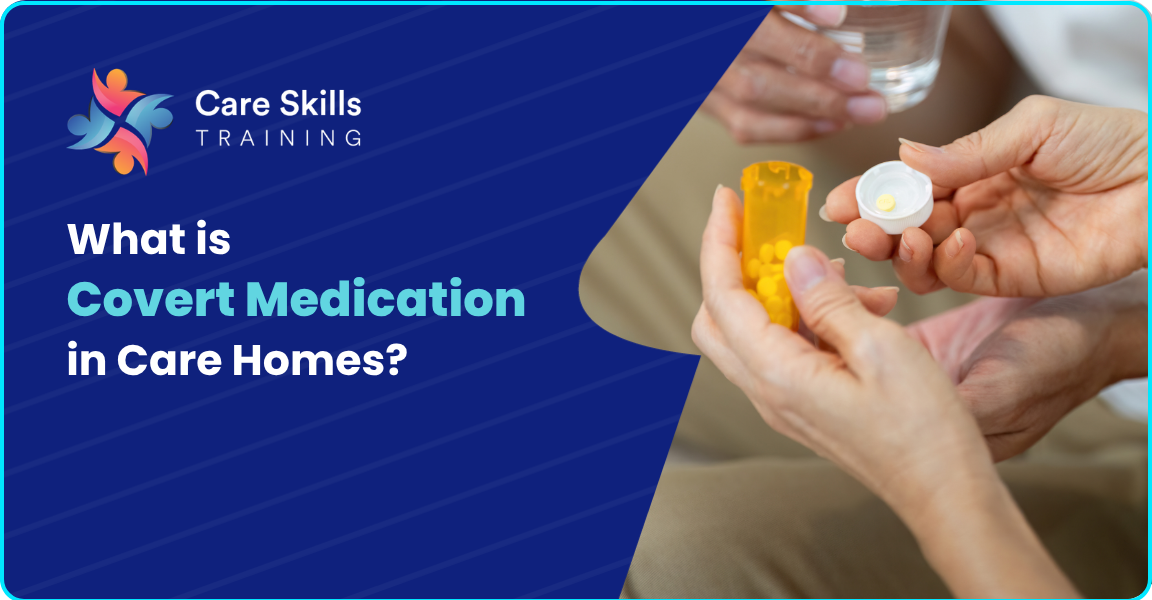
For many care home residents, medication is an important part of their health and wellbeing. There are times when an individual will not take a prescribed drug even though it is deemed important to their health. In those situations, care staff might consider covert medication administration. So, what is covert medication in care homes?
Covert medication is giving a person their medicine in a hidden manner, such as disguised in food or drink, without their knowledge or awareness. When someone is unable to make decisions about their medicine and they are refusing medicine, covert medication is usually taken into consideration if their refusal to take medicine may have serious consequences for their health.
This guide outlines how covert medication works, when it might be necessary, legal issues relating to the use of covert medication in the UK and how care homes can use this process safely and respectfully.
What Is Covert Medication Administration?
When you give medicines support to someone without his or her knowledge or consent, it is called covert medication. Typically, this involves concealing the medicine in food or fluid, such as hiding a tablet in applesauce, dissolving a pill in juice or mixing it in with pudding.
However, it should be noted that giving medication covertly is not a common practice and should never be utilised just because a person rejects medication. It is a serious matter and needs to be considered carefully, taking into account the rights, wishes, safety and overall wellbeing of the individual.
The guidance of organisations like the Care Quality Commission (CQC) and the National Institute for Health and Care Excellence (NICE) in the UK stresses that covert medication should only be used as a last step where there is a clear need and appropriate safeguards are in place.

Why Is Covert Medication Administered in Care Homes?
In a care home setting, there may be a number of reasons for administering medicines covertly. It most commonly occurs when someone requires a critical medication but is constantly refusing to take it, due to their lack of understanding of the implications of not taking a medication.
Covert medication may be considered in the following situations:
People living with dementia
Dementia can cause people to notice changes to their memory, thinking or awareness. Sometimes they may not realise they need a medication or appreciate the importance of taking one.
For instance, someone with late-stage dementia might not want meds because they think they do not require them or they may not remember that they were discussed before.
Individuals with learning disabilities or cognitive impairments
Some people may not be able to get information about their medicine or decide on treatment. If someone is unable to understand, remember or consider information about medicines, a capacity assessment might be needed.
Individuals suffering from some mental health issues
A person may not be able to understand treatment choices due to some mental health issues. In these circumstances, it may be necessary for professionals to closely review their capacity to make decisions regarding medication.

Is Covert Medication Legal in the UK?
Yes, covert medication can be legal in the UK, but only when strict conditions are met. Care homes can’t just give covert medication because it’s easier or because residents are being difficult. There has to be genuine legal justification.
The Care Quality Commission inspects this. If they find covert medication being given without proper processes, it is a serious problem that can lead to poor ratings or enforcement action
One of the most important pieces of legislation connected with covert medication is the Mental Capacity Act 2005. The Mental Capacity Act provides guidance on making decisions for people who may not have the ability to make certain decisions themselves.
Under this framework, professionals must consider:
- Whether the person has the capacity to make decisions about administering medication
- Whether all reasonable alternatives have been explored
- Whether covert medication is in the person’s best interests
- Whether the decision is the least restrictive option
The Care Act 2014 is also important when supporting adults who may be at risk of harm or neglect. Health and social care providers must ensure that medication practices protect dignity, safety, and individual rights.
What Is the Process for Giving Covert Medication Safely?
If covert medication has been properly approved, there’s a specific process to follow. Let me share the step-by-step process for giving covert medication safely.
Step 1: Capacity assessment
A healthcare professional such as a GP, nurse, or psychiatrist properly assesses whether the person has capacity to make this specific medication decision. This isn’t casual, it is a formal assessment using the Mental Capacity Act test.
Step 2: Best interests meeting
If you assume that a person lacks capacity, a multidisciplinary meeting happens involving the person’s GP, care staff, family members if involved, and sometimes an independent advocate. Documentation from this meeting is crucial. Written records of the discussion, decision, and reasoning.
Step 3: Formal authorisation
Usually a GP or senior healthcare professional gives formal authorisation in writing. This becomes part of the person’s medical records.
Step 4: Detailed care plan
A specific care plan documents exactly how the medication will be given, which food or drink it is hidden in, who is giving it, when, how you will check they have taken it, and what you will do if they refuse.

Step 5: Ongoing monitoring
Regular reviews should happen. At least every three months, sometimes more frequently. Is it still working? Is the person’s condition improving or stable? Is covert administration still necessary? Could they take it openly now? Documentation of every review is essential.
Step 6: Recording and audit
Every time you administer covert medication, it should be recorded. Dates, times, medications, and the person administering it. This audit trail shows that the process is being followed properly.
What Are the Risks of Covert Medication?
Although covert medication is beneficial but it still carries real risks, which is why it’s so tightly regulated.
Therapeutic risk
Some medications shouldn’t be hidden. Time-release tablets lose their effect when crushed. Some medications taste bitter or cause nausea if mixed with food, which might make the person sick.
Nutritional impact
Hiding medication in certain foods might affect nutrition. If you are hiding essential medication in applesauce and someone does not eat anything else, that could be a problem.
Dignity and autonomy
Even with best intentions, there can be something wrong about giving someone medication without their knowledge. It could be a violation of autonomy, even if necessary.
Legal risk
If you get the process wrong, then you are potentially breaking the law. Staff administering covert medication without proper authorisation can face serious consequences.
Trust
Trust is a critical component in the relationship between individuals receiving care, their families, and the care team. When covert medication is administered without proper explanation, it can lead to a significant breach of trust.

How Should Care Homes Manage Covert Medication?
Proper management isn’t complicated, but it does require genuine commitment. Here’s how care homes can manage covert medication.
Before starting
Get the foundations right before you even think about giving medication covertly. That means a proper capacity assessment, not a quick chat, but a formal assessment by someone qualified. Create a detailed care plan that explains exactly how the medication will be hidden, when it will be given, who is giving it, and how you will monitor it.
During administration
Once it is approved and you are actually giving the medication, follow the care plan exactly. Do not improvise or think you can do it slightly differently today. Watch carefully for any side effects or adverse reactions. If someone becomes nauseous after you have hidden medication in their juice, you need to know about that immediately.
Ongoing reviews
Do not just set up covert medication and assume it will stay that way forever. At least every three months, have a proper review. Evaluate if it is still necessary, and whether the person’s condition is improving, stable, or declining. These reviews will make sure you are still doing the right thing.
If capacity returns
Although it is less common, sometimes people regain capacity. Someone’s dementia might stabilise. Someone who was profoundly confused might become clearer. If that happens, everything changes. They now have the right to consent or refuse like anyone else. You need to revisit the decision with them properly.
Transparency with families
Families should know what is happening and why. Being honest about covert medication doesn’t mean apologising for it or acting like you are doing something wrong. It means explaining clearly. That transparency builds trust, not breaks it.
Training everyone involved
Healthcare professionals and all staff who might be involved in administering covert medication, such as nurses, care assistants, and even people who prepare food, need proper training. They need to understand why it is necessary, not just how to do it. They need to understand the ethical issues involved, the legal framework, and how to spot problems.


Benefits of Proper Covert Medication Management
When done right, covert medication can genuinely help. Here’s what actually happens when proper covert medication management is done.
People get essential treatment
Someone who genuinely needs heart medication to stay alive actually gets it. Not because you are forcing them, but because you have made a proper decision that it is in their best interest. They stay healthier, live longer, and experience better quality of life.
Prevents deterioration
Without proper medication management, people decline fast. You see it happen like someone stops taking their medication, and within weeks they are confused, weak, and at risk of falls. Proper covert administration, done with all the right processes in place, prevents that unnecessary suffering and decline.
Reduces crisis
Instead of hoping someone does not get acutely unwell and end up in hospital, proper medication keeps them stable. That means fewer emergency admissions, fewer scary crises for the person and their family, fewer disruptions to their life. Someone who is stable can stay in their care home, in their familiar surroundings, with their routine.
Improves wellbeing
Health and mood are connected. Someone who’s physically unwell is often depressed, withdrawn, disengaged. When you get their medication right, even if it is covert medication, they often brighten up. Better health means better mood, more engagement with activities, better quality of life.

Protects staff
Proper processes protect care staff from doing something illegal or unethical without realising it. Staff members of adult social care services sometimes struggle with covert medication as it feels wrong to them, even when it’s necessary. Having clear processes, proper authorisation, and knowing they are following approved procedures gives them confidence that they are doing the right thing.
Maintains dignity
This might sound odd when you are talking about giving someone medication without their knowledge. But when done properly with genuine capacity assessment, proper best interests meetings, ongoing reviews, and family involvement, it is actually about protecting someone’s wellbeing while respecting their rights as much as possible.


Frequently Asked Questions
1. Do you need a DoLS to give covert medication?
If the person is in either a hospital or care home, the managing authority must apply for Deprivation of Liberty Safeguards (DoLS) authorisation to give covert medication.
2. What is the NICE guidance on giving covert medication?
The main NICE guidance on administering covert medicine states that medications should not be given covertly until a best interests meeting has taken place.
3. What are the 5 rules for the administration of medication?
The five rules for the administration of medication are: the right patient, the right drug, the right dose, the right route, and the right time.
4. Can a caregiver dispense medication?
In most cases, caregivers can assist with medication management, but they cannot administer medication without proper training or nurse delegation.
Final Thoughts
Before utilising covert medication, it is crucial to understand what is covert medication in care homes actually means. Covert medication is controversial because it involves doing something to someone without their knowledge. But sometimes it is necessary and appropriate when someone lacks capacity, when their health genuinely depends on it, and when proper legal processes have been followed.
The key is doing it properly. Not rushing into it, not treating it casually, not using it as an easy option. Following the Mental Capacity Act, doing proper capacity assessments, holding best interests meetings, getting authorisation, documenting everything, and regularly reviewing. Care homes that do this well protect both the people they support and themselves.




Level 3 Safeguarding Children and Vulnerable Adults
4.94.9Original price was: £119.00.£29.99Current price is: £29.99.
4407 Students

4 Hours

Level 5 Designated Safeguarding Lead (DSL)
4.94.9Original price was: £199.00.£49.99Current price is: £49.99.
4199 Students
7 Hours
-
3409 Students
17 Hours





0 responses on "What Is Covert Medication in Care Homes? A Complete Guide for Care Workers"