


Our Most Popular Categories
Trending
Health and Social Care
First Aid
Care Certificate
Food Hygiene
Mental Health
Safeguarding
Health and Safety
Animal Care & Training
Business Essentials
Career Bundles
Other Courses

- Accredited Dog First Aid, CPR and Grooming
- Pet Nutrition Diploma
- Pet First Aid and CPR Certification
- Pet Care and Psychology Diploma
- Learn to Launch and Grow a Pet Business
- Cat First Aid, CPR and Emergency Care
- Complete Dog Behaviour and Training
- Dog First Aid, CPR & Grooming + Safety for Pet Pros & Owners
- Care Certificate Course
- Mandatory Training For Care Staff and Care Workers
- Level 2 Safeguarding Children and Vulnerable Adults
- Care Planning and Record Keeping in Health and Social Care
- Family Support Worker Training
- Training For Care Workers (Complete Package)
- Care Certificate Standards (1 to 16) + Level 2 And 3 Diploma in Health and Social Care
- Mandatory Training for Care Home Staff Training
- Mandatory Training For Care Staff and Care Workers
- Mandatory Training for Care Home Staff Training
- Mandatory and Statutory Trainings For Adult Social Care
- Mandatory Training For Care Assistants
- Mandatory and Core Social Care Courses
- Mandatory Training For Agency Nurses
- Mandatory Training for General Practitioners
- Mandatory Training For Support Workers
- Personal Assistant Job Ready Programme
- Health and Safety Job Ready Programme
- Project Management Job Ready Programme
- Virtual Assistant Job Ready Programme
- Teaching Assistant Job Ready Programme
- Assistant Manager Job Ready Programme
- Healthcare Support Worker Job Ready Programme
- Office Manager Job Ready Programme
- Problem Solving in Leadership: Lead Your Team to Success
- Surviving Office Politics: Mastering Workplace Relationships
- Business Fundamentals Course Online
- Unconscious Bias Training
- ISO 9001 Quality Management System Training (Clauses 6-10)
- ISO 9001 Quality Management System Training (Clauses 1–5)
- Emotional Intelligence Training
- Personal Assistant Job Ready Programme
- Health and Safety Job Ready Programme
- Project Management Job Ready Programme
- Teaching Assistant Job Ready Programme
- Assistant Manager Job Ready Programme
- Healthcare Support Worker Job Ready Programme
- Office Manager Job Ready Programme
- Designated Safeguarding Lead (DSL) Job Ready Programme
- Level 3 Safeguarding Children and Vulnerable Adults
- Level 5 Designated Safeguarding Lead (DSL)
- Safeguarding Level 4 Training
- Designated Safeguarding Lead (Level 3 DSL Training)
- Safeguarding Adults Level 3
- Level 2 Safeguarding Children and Vulnerable Adults
- Level 3 Diploma in Nursing Assistant Training
- Safeguarding Adults Training Level 3
- Diabetes Awareness Training
- Baby Massage Training
- Employment Law Training
- Learn to Launch and Grow a Pet Business
- Complete Dog Behaviour and Training
- Dog First Aid, CPR & Grooming + Safety for Pet Pros & Owners
- Drugs and Alcohol Awareness Training
- Dog Care, Dog Grooming, and Dog First Aid Course Online
- Care Certificate Standards 1-16 (The Complete Bundle)
- Training For Care Workers (Complete Package)
- Care Certificate Standards (1 to 16) + Level 2 And 3 Diploma in Health and Social Care
- Mandatory Training for Care Home Staff Training
- First Aid Essentials 1 to 6 Bundle
- Leadership and Management Courses
- Mandatory and Statutory Trainings For Adult Social Care
- Level 3 Admin PA and Secretarial Diploma Bundle
- Yearly Subscription: Unlimited Access to 300+ Courses
- Level 3 Safeguarding Children and Vulnerable Adults
- Level 5 Designated Safeguarding Lead (DSL)
- Care Certificate Course
- Safeguarding Level 4 Training
- Health and Social Care Level 3 Diploma
- Accredited Dog First Aid, CPR and Grooming
- Trauma-Informed Care Training



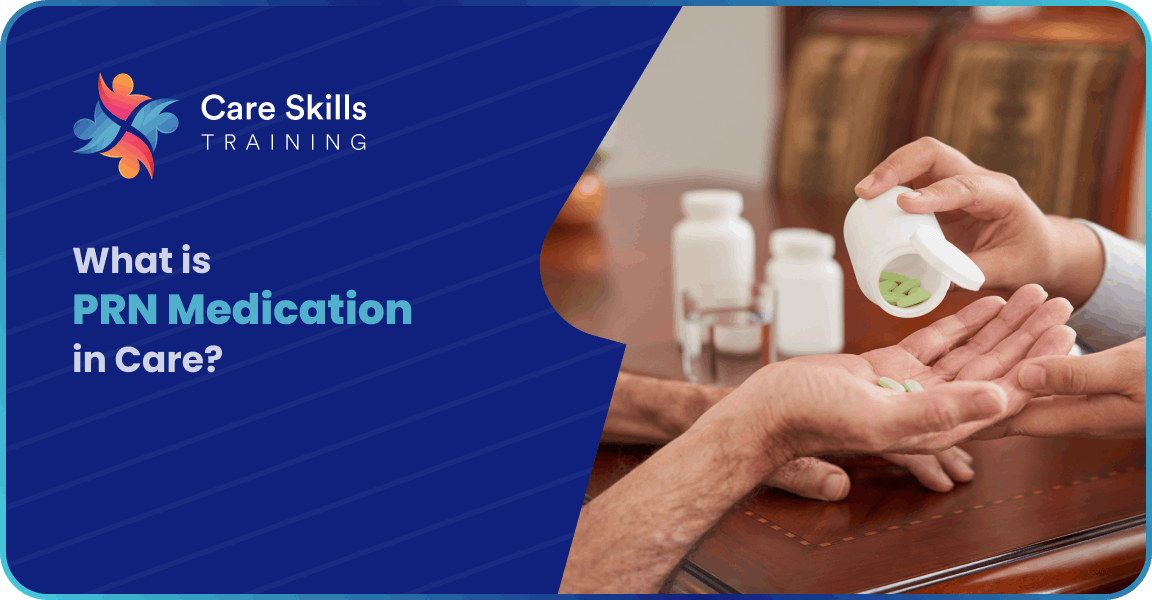
Administering medication to the patient is one of the key responsibilities for care workers. Some medications are not given at fixed times but are given only when needed. This is where PRN medication comes in.
What is PRN medication in care? PRN medication in care means the medication given “when needed” or “as required”. PRN stands for “pro re nata”, which is a Latin phrase. These medications are prescribed to treat intermittent or short-term illness, such as nausea, vomiting, constipation, anxiety, insomnia, etc.
This blog post will explore the care plan, timing, training and protocol for administering PRN medication. Let’s explore.
What is PRN medication in care?

PRN stands for “pro re nata”, a Latin phrase which translates to “as required” or “when needed”. PRN medication refers to medications which are given to patients only when needed. So, these medications don’t have a fixed time to give.
Another thing you must remember is that PRN medicine must be prescribed or authorised for an individual. Otherwise, you can not give this medication to the patient. As a care staff member, you must check the MAR/eMAR records of the patient before giving them PRN medication.
When are PRN medications required?
The purpose of PRN medication is to treat intermittent or short-term illness. So, a PRN medication is given when someone is having
- Shortness of breath
- Pain
- Anxiety
- Constipation
- Nausea, vomiting, or indigestion
- Insomnia
- Allergic reaction
Healthcare workers need to address the patient’s symptoms and provide the PRN medication. However, if the medication is not prescribed, then as a care staff member, you must consult with the GP or the prescriber.
When should care staff give PRN medication?

A care staff member can give PRN medication to the patient when they show clear signs or symptoms of intermittent illness.
If any of your patients ask for the medication, as a healthcare professional, you can give PRN medicines only if certain conditions and criteria are met. This is because care workers do not have the authority to make clinical decisions on their own.
So, when a care staff member is giving PRN medication to their patient, they must check the patient’s PRN protocol and MAR chart. A trained care worker can easily understand these protocols. That’s why completing training on PRN medication is also essential for them.


What are the care plans for PRN medication?
A care plan for PRN medication is a documented explanation of how a person should receive their “when required” medication. This patient care plan includes the reasons, timing, and instructions on how to give PRN medicines.
This is how a typical care plan for PRN medication looks:
| Section | What it covers |
| Person’s needs/condition | The health condition or need that may require PRN medication |
| Support needed | How the person may need help recognising, communicating or managing symptoms |
| Medication in use | Which PRN medication(s) they’re prescribed. For details, look at the PRN protocol section |
| How the person prefers to be supported | The person’s preferences around being asked/offered medication, and any non-medication approaches to try first |
| Communication needs | How the person typically shows or communicates that they need support (verbal or non-verbal signs) |
| Risks | Any risks linked to the condition, the medication, or not receiving it in time |
| Related documents | Links to the PRN protocol, MAR chart, and any relevant prescriber correspondence |
| Review date | When the care plan (and this section) is next due for review, or sooner if needs change |
What is the protocol for administering PRN medication?
The care plan described in the previous part was to understand the patient. The protocol for administering PRN medication describes the medication and the rules for a specific PRN drug.
The protocol includes the exact dose, maximum frequency, when to contact a senior colleague or prescriber, etc. This ensures that no medication errors are made.
This is how a typical protocol for PRN medication looks:
| Topic | Example entry |
| Patient’s details | Name, date of birth, NHS number (if used) |
| PRN medication | Medication name and strength |
| Prescribed by / date started | Prescriber name and start date |
| Reason for use | The specific condition or symptom it treats |
| Signs and symptoms | Observable signs staff should look for |
| Who identifies the need? | Whether the person requests it, or staff offer it based on observed signs |
| Dose and route | Exact prescribed dose and how it’s given |
| Minimum interval | Time required between doses |
| Maximum in 24 hours | Prescribed maximum dose/frequency |
| Variable-dose guidance | How staff choose between a lower/higher dose, if a range is prescribed |
| Checks before giving | MAR/eMAR check, previous doses, allergies, consent/capacity |
| Alternatives first | Non-medication approaches to try before administering |
| Expected outcome | What improvement should look like |
| Outcome check | When and how to reassess and record the response |
| If ineffective or worsening | Who to inform and when to escalate |
| Recording | What must be logged after giving the medication |
| Review | When the protocol is next due for review |
How to administer PRN medication?

For administering PRN medication, maintaining a structured order can be helpful. Following a step-by-step process ensures that the decisions you make as a care worker are based on evidence rather than following your instinct.
Step 1: Check the care plan, prescription, MAR/eMAR chart and PRN protocol
The first step comes even before administration of PRN medication. This is the pre-phase where you check the care plan, PRN prescription, MAR/eMAR chart and the PRN protocol of the patient.
In this step, you will have to confirm the validity of the prescription. As a care worker, you have to check that there is a current, authorised medication instruction. Also check that the medicine matches the details on the MAR/eMAR chart.
Step 2: Assess whether the patient needs the medication
Before taking any action, you must assess the patient and what they are saying or observe their behaviour. Observe them for signs of the illnesses for which they will need PRN medication. Then compare those with the signs and symptoms listed in the PRN protocols.
If the patient has the mental capacity to request the PRN medication for themselves, listen to them rather than relying on your observation.
When the symptoms don’t match the protocol, and the medication is not prescribed for those symptoms, do not administer it. Consult with a senior care worker, GP or the prescriber for guidance.
Step 3: Check the MAR chart and previous administration
If the patient is displaying the signs or symptoms of intermittent illnesses, before giving the medication, always check the MAR chart, dose, and previous administration. This tells you whether enough time has passed for the next dose or not. Check for the maximum daily dosage limit for each medication.
Step 4: Administer the medication according to instructions
Follow the instructions already given by the patient’s GP. As a care worker, your job is to always confirm that you have the right medication at the right time before administering.
In these kinds of situations, getting confused is not unusual. So, if anything feels unclear or doesn’t match the protocol, take a pause and consult if you need to, rather than guessing.
Step 5: Monitor the patient’s response and check for side effects
The most crucial part of administering PRN medication is to monitor the patient’s response after giving them the medication. Even after following the PRN protocol and care plan.
Check if the medication is working or not. If the medication doesn’t work, then you must inform the GP, PRN nurse, or senior carer. In the meantime, you can keep a record of the side effects that are occurring.
Step 6: Record the medication given and its outcome
In care, a simple sign can reveal hidden symptoms. That’s why recording information about the given medication, the outcome, side effects, and even the little things is important.
Record-keeping also helps the next person who will be in charge of the patient after you. This also makes you compliant with the CQC Standards.
Why is training important for PRN medication?
A simple mistake, like a small irregularity in the dosage of PRN medication, can have huge consequences. PRN medication training clarifies the concepts of PRN protocols, PRN administration, PRN orders, medication use, medication management, etc.
For healthcare providers, medication administration training is more than just compliance. This builds a consistent standard across the whole team. When a care staff member completes training on medication management, they get a complete guide on the regulations.
FAQ
What is an example of a PRN medication?
Common examples include paracetamol or other painkillers for pain, laxatives for constipation, inhalers for breathing difficulties, and medication for nausea or anxiety. Each PRN medication is prescribed for a specific symptom and should only be given according to the person’s individual PRN protocol.
Can you give PRN meds an hour early?
No, not unless the protocol specifically allows it. Giving medication early can breach the minimum interval between doses and risk exceeding the maximum daily amount. Always check the MAR chart and protocol first, and if in doubt, consult a senior colleague or the prescriber.
What is the PRN protocol for paracetamol?
It varies by person, but typically includes a dose of 500mg to 1g, a minimum four hour interval, and a maximum of four doses in 24 hours. Always follow the specific protocol and prescription for that individual, not a general guideline.
Conclusion
Managing medicines for patients or clients needs to be done with high priority. And when it comes to PRN medication, following the PRN protocol and care plan is a must.
PRN medication doesn’t have any fixed time frame. These medicines are only given when needed. That is why it is called “pro re nata (PRN)”, which means “as needed” or “when required”. In this blog, we have covered everything that you need to know about what is PRN medication in care.
Follow the guide, complete the training and take proper steps before giving PRN medication to your patient or client.




Level 3 Safeguarding Children and Vulnerable Adults
4.94.9Original price was: £119.00.£29.99Current price is: £29.99.
4407 Students

4 Hours

Level 5 Designated Safeguarding Lead (DSL)
4.94.9Original price was: £199.00.£49.99Current price is: £49.99.
4199 Students
7 Hours
-
3409 Students
17 Hours





0 responses on "What Is PRN Medication in Care? Everything You Need to Know"