


Our Most Popular Categories
Trending
Health and Social Care
Safeguarding
First Aid
Care Certificate
Food Hygiene
Mental Health
Health and Safety
Animal Care & Training
Business Essentials
Career Bundles
Other Courses

- Yearly Subscription: Unlimited Access to 500+ Courses
- Level 3 Safeguarding Children and Vulnerable Adults
- Level 5 Designated Safeguarding Lead (DSL)
- Care Certificate Course
- Safeguarding Level 4 Training
- Health and Social Care Level 3 Diploma
- Accredited Dog First Aid, CPR and Grooming
- Trauma-Informed Care Training
- Level 3 Safeguarding Children and Vulnerable Adults
- Level 5 Designated Safeguarding Lead (DSL)
- Safeguarding Level 4 Training
- Designated Safeguarding Lead (Level 3 DSL Training)
- Safeguarding Adults Level 3
- Level 2 Safeguarding Children and Vulnerable Adults
- Level 3 Diploma in Nursing Assistant Training
- Safeguarding Adults Training Level 3
- Care Certificate Course
- Mandatory Training For Care Staff and Care Workers
- Level 2 Safeguarding Children and Vulnerable Adults
- Care Planning and Record Keeping in Health and Social Care
- Family Support Worker Training
- Training For Care Workers (Complete Package)
- Care Certificate Standards (1 to 16) + Level 2 And 3 Diploma in Health and Social Care
- Mandatory Training for Care Home Staff Training
- Accredited Dog First Aid, CPR and Grooming
- Pet Nutrition Diploma
- Pet First Aid and CPR Certification
- Pet Care and Psychology Diploma
- Learn to Launch and Grow a Pet Business
- Cat First Aid, CPR and Emergency Care
- Complete Dog Behaviour and Training
- Dog First Aid, CPR & Grooming + Safety for Pet Pros & Owners
- Care Certificate Standards 1-16 (The Complete Bundle)
- Training For Care Workers (Complete Package)
- Care Certificate Standards (1 to 16) + Level 2 And 3 Diploma in Health and Social Care
- Mandatory Training for Care Home Staff Training
- First Aid Essentials 1 to 6 Bundle
- Leadership and Management Courses
- Mandatory and Statutory Trainings For Adult Social Care
- Level 3 Admin PA and Secretarial Diploma Bundle
- Diabetes Awareness Training
- Baby Massage Training
- Employment Law Training
- Learn to Launch and Grow a Pet Business
- Complete Dog Behaviour and Training
- Dog First Aid, CPR & Grooming + Safety for Pet Pros & Owners
- Drugs and Alcohol Awareness Training
- Dog Care, Dog Grooming, and Dog First Aid Course Online

Offer Ends In
Use Code


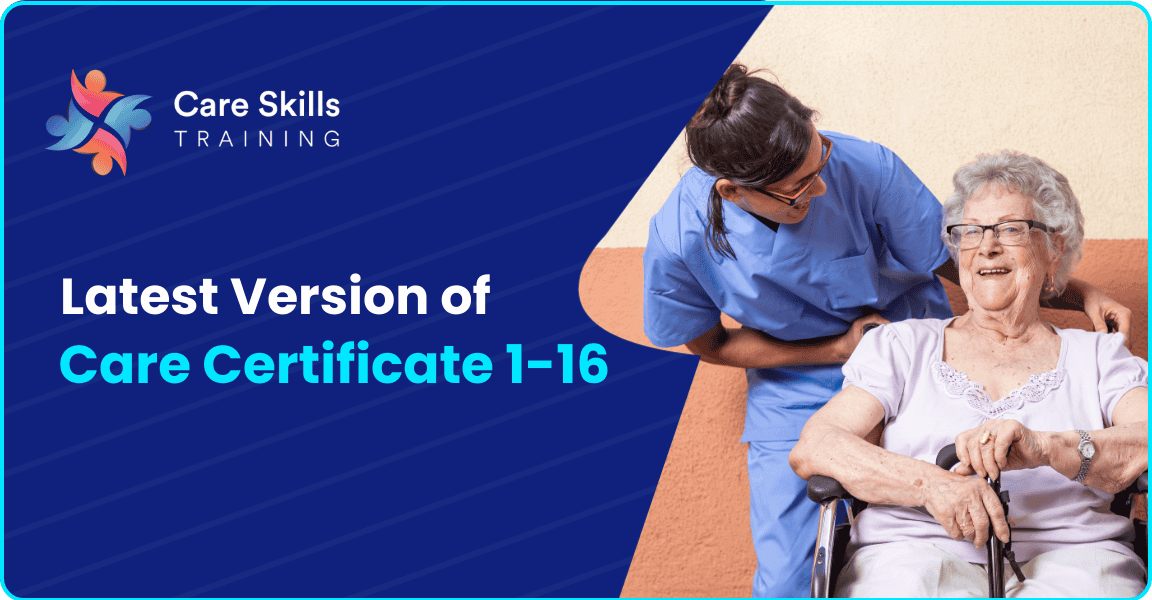
If you want to complete the Care Certificate training, you may be wondering, “What is the latest version of the Care Certificate?”. Because learning an older version of the Care Certificate often wastes your valuable time.
The latest version of the Care Certificate is the standard 16: Awareness of learning disability and autism. It has been added to the previous 15 standards, making the Care Certificate a set of 16 care standards in total. NHS, Skills for Health and Skills for Care cooperatively brought this update in March 2025.
The information about the latest version of the Care Certificate is crucial if you want to pursue your career in health and social care. It helps you to stay up to date while providing safe and compassionate support to your clients.

The Care Certificate Explained
Starting a career in the health care and social care sector can feel a bit overwhelming, especially if you have no previous training record. In UK, people often take the Care Certificate as their first step.
Well, the Care Certificate is not that hard to understand. In fact, it’s pretty simple and straightforward.
You can think of the Care Certificate as your starter pack for becoming a professional and confident caregiver. It teaches you the essential knowledge and skills to support those who need additional help.
The Care Certificate definition
The Care Certificate is an accumulation of care standards that caregivers are bound to follow in their professional practice. The training covers 16 Care Certificate standards of caregiving, such as duty of care, communication, adult support, child support, and basic life support.
In short, the Care Certificate helps you to learn the essential skills in a structured approach, before working with patients on your own.
Why the Care Certificate introduced in UK?
The Care Certificate was launched in 2015 to provide improved and consistent care support across UK by The National Health Service England (NHS), Skills for Health and Skills for Care.
Previously, the care workers entered into health and care roles without proper training. This led to patient safety risks and lower quality of care services. To fix the issue, the Care Certificate was introduced.
The Care Certificate was created to:
1. Set a clear minimum standard
2. Give safe and person-centred care
3. Form a strong foundation of skills and confidence
4. Create a universal training curriculum
5. Provide consistent care across UK
The core aim behind the introduction of the Care Certificate was to ensure consistent care services by enforcing the 16 Care Certificate standards across UK. As a result, skilled caregivers with the same training would be produced, and the overall quality of care and public trust would be improved.
Who is the Care Certificate designed for?
The Care Certificate is mainly designed for entry-level roles in the health care and social care sector. If you’re just starting out in the sector but don’t have any formal qualifications yet, the Care Certificate is your entry point.
The Care Certificate is aimed at roles such as:
▪️Care Assistant
▪️Care Support Worker
▪️Home Care Worker
▪️Adult Care Worker
▪️Personal Assistant
The Care Certificate is for the unregulated workforce who don’t have any previous training in the health care and social care sector. Doctors and nurses already have higher professional training, so they don’t need the Care Certificate.
If we cut the story short, the Care Certificate course is designed to gain essential skills, knowledge and confidence to care for others with safety and respect.


The Care Certificate standards
As mentioned earlier, the Care Certificate comprises 16 care standards. These are the essential areas of knowledge and practice that every care worker needs to master before working on their own.
You can think of the Care Certificate standards as your roadmap to safe, compassionate, and person-centred care delivery.
Overview of the Care Certificate standards
The Care Certificate standards are more than just rules. They’re the foundation of trust between workers, employers and the people receiving support.
Here’s what the Care Certificate standard includes:
1. Understand your role: Describes what’s expected of you as a care worker.
2. Your personal development: Learning and improving yourself.
3. Duty of care: Knowing your responsibilities to keep people safe.
4. Equality and diversity: Treating everyone fairly and respectfully.
5. Work in a person-centred way: Putting the patient’s needs at the centre of your responsibility.
6. Communication: Building strong and clear communication skills.
7. Privacy and dignity: Respecting people’s personal space and rights.
8. Fluids and nutrition: Healthy eating and drinking support.
9. Awareness of mental health, dementia, and learning disabilities: Understanding the different conditions and needs of the clients.
10. Safeguarding adults: Protecting adults from harm and abuse.
11. Safeguarding children: Knowing how to keep children safe.
12. Basic life support: Learning how to respond in emergency situations.
13. Health and safety: Ensuring a safe and secure environment for everyone.
14. Handling information: Recording and sharing information properly.
15. Infection prevention and control: Reducing the risk of spreading infections.
16. Awareness of learning disability and autism (NEW): Understanding the different learning disability conditions, especially autism.
What skills and knowledge Care Certificate standard cover?
The Care Certificate standards give both essential knowledge and practical skills to its learners. Here’s a quick breakdown:
Essential Knowledge
🔹Role understanding
🔹Duty of care
🔹Equality, diversity and inclusion
🔹Person-centred support
🔹Safeguarding
🔹Infection control and health safety
Practical Skills
🔹Effective communication
🔹Maintaining privacy and dignity
🔹Nutrition and hydration
🔹Basic life support
🔹Handling information
These essential knowledge and practical skill areas ensure that every care worker becomes capable of delivering safe and reliable care, regardless of their role or setting.
Why the Care Certificate standards are important in care?
The Care Certificate standards aren’t just a check-list exercise. They set the foundation for safe, consistent, and effective care.
The Care Certificate standards are very important because they:
🔹Protect patients and service users by ensuring every caregiver has the same minimum level of training. As a result, people can feel safe and respected.
🔹Families know that caregivers have learned the essentials before working on their own. Hence, the Care Certificate standards build trust among citizens.
🔹The care standards give caregivers confidence to handle real-life situations.
🔹Whatever the setting of caregiving, the basics of care remain the same everywhere. This develops consistency.
🔹These standards are like stepping stones for caregivers. They become eligible to take advanced training and ultimately induce career growth.
In summary, the care standards ensure competent and trustworthy care from care workers.
What is the latest version of the Care Certificate in 2025?
Now we know that the original Care Certificate was introduced in 2015. At that time, there were 15 care standards, and the care workers needed to learn these 15 standards. But it’s not enough anymore.
The Care Certificate’s most recent version was updated recently. To be precise, it was launched in March 2025.
The transition period between 2015 and 2025 is currently ongoing. The original 15 standards will remain as a reference until the end of 2025. The goal behind this is to facilitate organisations’ smooth switch to the updated version of the Care Certificate standards.
Who manages and updates the Care Certificate framework?
The Care Certificate is a collaborative effort. The National Health Service England (NHS), Skills for Health and Skills for Care are collectively responsible for the Care Certificate framework.
Employers then use this framework to train care workers. The Care Quality Commission (CQC) oversee and regulates employers to produce a competent care workforce.
What are the key changes or improvements in the Care Certificate?
The 2025 update expanded the original 15 standards to 16 care standards. The new standard is: Awareness of learning disability and autism. So, the most recent update of the Care Certificate standards added a special focus on learning disabilities and autistic conditions.
The refreshed version of the Care Certificate standard also aims to align with the new Level 2 Adult Social Care Certificate qualification. This will facilitate the advanced Level 2 Adult Social Care Certificate qualification process.


Do caregivers need to update their Care Certificate training?
Once you complete the Care Certificate training, you don’t need to retake it anymore. It’s basically a lifetime achievement to meet the 16 care standards for an interested or existing care worker.
However, as a good learner, you shouldn’t stop learning after getting the Care Certificate. The smart approach is to keep your knowledge and skills up to date.
To keep your learning up to date, you can do these:
1. Regular refresher training is a good choice to stay up to date with the latest developments in the health care and social care sector.
2. Higher training opportunities are also a wise decision for your sustainable career development.
So, think of the Care Certificate as your starting point. Continuous learning will help you to stay confident, competent, and ready for the ever-changing needs of the patients you support.
How employers ensure staff remain up to date?
Employers have a huge responsibility to ensure their staff remain up to date after the completion of the Care Certificate. Here’s how they generally do it:
1. Refresher training
2. Supervision and appraisals
3. Mandatory annual training
4. Ongoing CPD (Continuous Professional Development)
5. Policy and practice updates
Why updates matter for Care Certificate?
We know that health and social care sector is always evolving. Constantly, there are new challenges, medical knowledge, and working methods. All care workers need to keep learning to stay effective.
Here are some reasons why updates matter for Care Certificate:
1. Keeping care practices safe and effective: Updated standards make sure that care workers are trained to handle the latest risks and safeguarding issues. This’ll ensure the protection of the people.
2. Reflecting modern priorities: New issues are arising every day. For example, the 2025 update added a new standard for learning disability and autistic condition. Updates are needed for more inclusive care.
3. Building trust with patients and families: Families, patients, and employers feel assured when they know their caregivers are trained in current best practices.
4. Supporting career growth: The updates of the Care Certificate keep training aligned with new qualifications and open opportunities for career growth. For example, recently, the 2025 update has aligned the original Care Certificate with the Level 2 Adult Social Care Certificate qualification.
Why choose Care Skills Training as your Care Certificate provider in UK?
Care Skills Training stands as one of the UK’s leading care course providers. They are also one of the very first to offer the updated Care Certificate Training covering all 16 care standards. This ensures your learning reflects the latest requirements for today’s care workers.
Our courses are CPD-accredited, meaning they contribute directly to your professional development. Learning is simple and engaging with our clear, video-based lessons, and you have the freedom to study at your own pace. It’s perfect for people with busy schedules.
We’re also proud members of trusted organisations like ROSPA, AoHT, and UKRLP. These memberships highlight our strong commitment to industry standards and quality care. Plus, with 24/7 learner support, you’re left on your own.
Why Care Skills Training is a top choice:
▪️Covers the latest 16 Care Certificate standards
▪️Fully CPD-accredited
▪️Fun and easy-to-follow video lessons
▪️Self-paced learning: anytime, anywhere
▪️14-Day money-back guarantee
▪️Backed by trusted memberships (CPD, ROSPA, AoHT, UKRLP)
▪️24/7 learner support
If you’re looking for a flexible, reliable, and recognised way to earn your Care Certificate, Care Skills Training is here for you. Join thousands of learners who’ve already taken the next step in their care career with us today!
FAQ
Do I need to renew the Care Certificate?
No, you don’t need to renew your Care Certificate because it has no expiry date. So, the Care Certificate remains valid for a lifetime.
Is the Care Certificate the same across UK?
The Care Certificate is England-specific and mostly the same across UK. The 16 care standards are identical. However, Scotland, Wales, and Northern Ireland have their own induction frameworks, and the Care Certificate is not officially required there.
How often do the Care Certificate standard change?
There is no fixed interval between the standard changes of the Care Certificate. As soon as the situation demands a change, the responsible body announces changes to the Care Certificate standards.
Can I learn the Care Certificate update online?
There is no fixed interval between the standard changes of the Care Certificate. As soon as the situation demands a change, the responsible body announces changes to the Care Certificate standards.
Conclusion
So, what is the latest version of the Care Certificate? Well, 16 care standards is the latest version of the Care Certificate. The framework has been expanded from 15 original standards to 16 standards by adding awareness of learning disability and autism. This update ensures that care remains inclusive and aligned with modern priorities.
So, completing the latest version of the Care Certificate builds your confidence, skills and trust. Remember, the Care Certificate is your rigid foundation. Continuous learning and training will keep you prepared for the ever-evolving needs of the health and social care sector.




Level 3 Safeguarding Children and Vulnerable Adults
4.94.9Original price was: £119.00.£29.99Current price is: £29.99.
4508 Students

4 Hours

Level 5 Designated Safeguarding Lead (DSL)
4.94.9Original price was: £199.00.£49.99Current price is: £49.99.
4260 Students
7 Hours
-
3450 Students
17 Hours









0 responses on "What is the Latest Version of The Care Certificate in 2026?"