


Our Most Popular Categories
Trending
Health and Social Care
Safeguarding
First Aid
Care Certificate
Food Hygiene
Mental Health
Health and Safety
Animal Care & Training
Business Essentials
Career Bundles
Other Courses

- Yearly Subscription: Unlimited Access to 500+ Courses
- Level 3 Safeguarding Children and Vulnerable Adults
- Level 5 Designated Safeguarding Lead (DSL)
- Care Certificate Course
- Safeguarding Level 4 Training
- Health and Social Care Level 3 Diploma
- Accredited Dog First Aid, CPR and Grooming
- Trauma-Informed Care Training
- Level 3 Safeguarding Children and Vulnerable Adults
- Level 5 Designated Safeguarding Lead (DSL)
- Safeguarding Level 4 Training
- Designated Safeguarding Lead (Level 3 DSL Training)
- Safeguarding Adults Level 3
- Level 2 Safeguarding Children and Vulnerable Adults
- Level 3 Diploma in Nursing Assistant Training
- Safeguarding Adults Training Level 3
- Care Certificate Course
- Mandatory Training For Care Staff and Care Workers
- Level 2 Safeguarding Children and Vulnerable Adults
- Care Planning and Record Keeping in Health and Social Care
- Family Support Worker Training
- Training For Care Workers (Complete Package)
- Care Certificate Standards (1 to 16) + Level 2 And 3 Diploma in Health and Social Care
- Mandatory Training for Care Home Staff Training
- Accredited Dog First Aid, CPR and Grooming
- Pet Nutrition Diploma
- Pet First Aid and CPR Certification
- Pet Care and Psychology Diploma
- Learn to Launch and Grow a Pet Business
- Cat First Aid, CPR and Emergency Care
- Complete Dog Behaviour and Training
- Dog First Aid, CPR & Grooming + Safety for Pet Pros & Owners
- Care Certificate Standards 1-16 (The Complete Bundle)
- Training For Care Workers (Complete Package)
- Care Certificate Standards (1 to 16) + Level 2 And 3 Diploma in Health and Social Care
- Mandatory Training for Care Home Staff Training
- First Aid Essentials 1 to 6 Bundle
- Leadership and Management Courses
- Mandatory and Statutory Trainings For Adult Social Care
- Level 3 Admin PA and Secretarial Diploma Bundle
- Diabetes Awareness Training
- Baby Massage Training
- Employment Law Training
- Learn to Launch and Grow a Pet Business
- Complete Dog Behaviour and Training
- Dog First Aid, CPR & Grooming + Safety for Pet Pros & Owners
- Drugs and Alcohol Awareness Training
- Dog Care, Dog Grooming, and Dog First Aid Course Online

Offer Ends In
Use Code


What usually happens when you hire a staff who has only educational knowledge about their work?
Most of the time, they find it difficult to cope with the practical experience- right? And what happens when you train them practically and provide hands-on experience?
Well, you will find the answer here.
In this blog, we will discuss what staff training is and why staff training is important in health and social care. The blog will additionally cover staff development and health care programmes. We’ll also talk about the value of educating staff about new processes.
What is staff training?

Staff training refers to giving training to the staff to increase practical knowledge. Many organisations offer staff training to improve their employees’ skills and knowledge.
Staff training can be given in various ways, including online and in-person meetings. It is a continuous process that enhances the success of organisations.
Why is staff training important in health and social care?
Staff training is important because it helps care workers learn skills. By acknowledging skills through training, they can provide good care to the patient.


Proper training ensures healthcare professionals have the necessary skills to provide effective care. Here are some key reasons why staff training is important in health and social care:
✅ Staff training helps staff to address potential risks
✅ It develops strong communication
✅ Enhances collaboration and teamwork
✅ It builds confidence among staff members
✅ Helps staff to manage challenging situations
Good training also ties directly into protecting health, safety and wellbeing in health and social care, since staff who understand the risks are better placed to keep both themselves and the people they support safe.

Staff training in health and social care
Staff training in health and social care is for professional development. This training makes sure that staff are capable of providing care. It also:
☑️ Ensures compliance
☑️ Enhances clinical skills
☑️ Improves communications
☑️ Supports awareness
☑️ Creates a positive culture
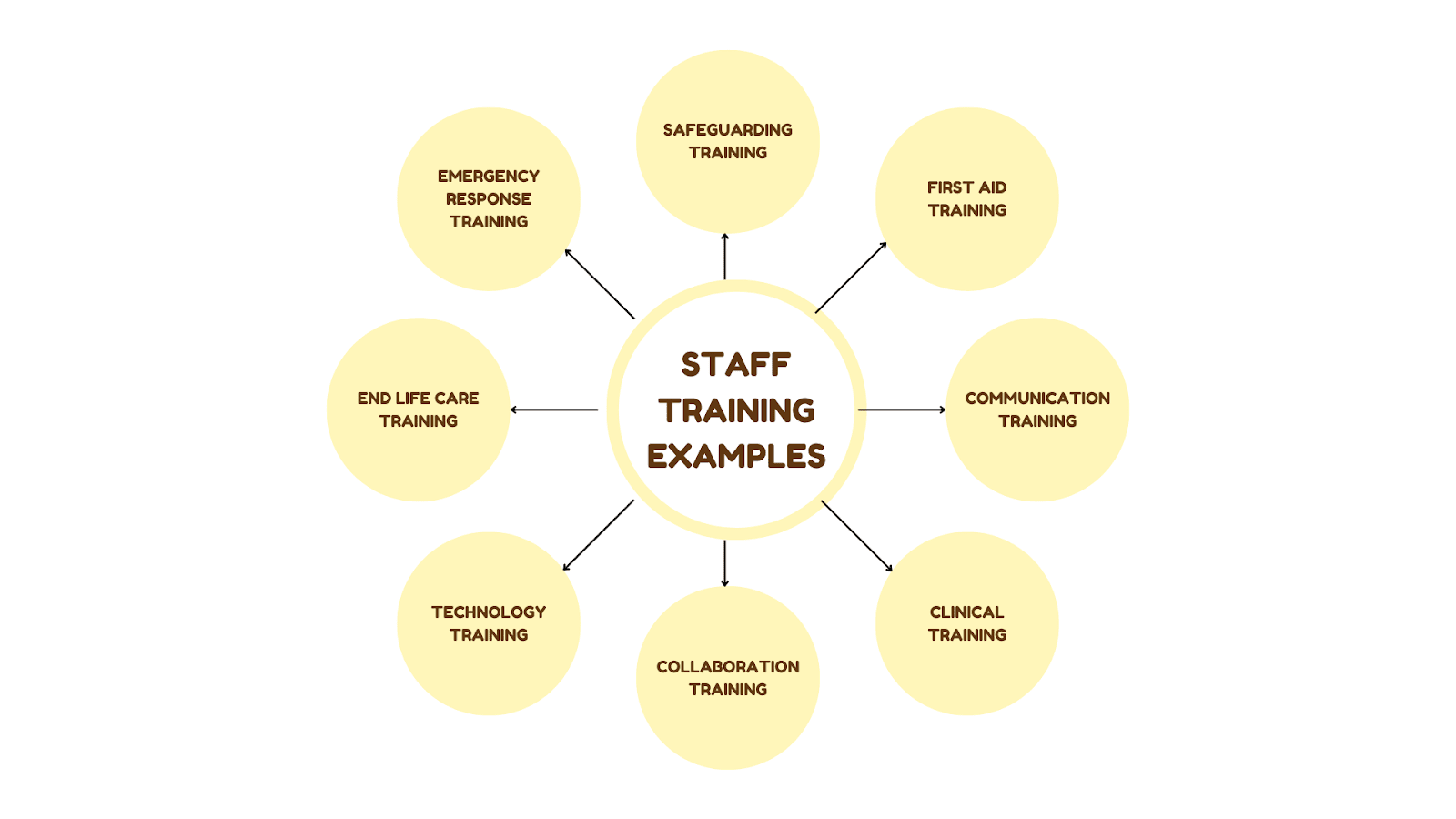
Staff training examples
Staff training in health and social care includes many topics to ensure the staff acknowledges all the necessary skills. The examples below are some of them:
☑️ Safeguarding training
☑️ First aid training
☑️ Communication training
☑️ Clinical training
☑️ Collaboration training
☑️ Technology training
☑️ End-life care training
☑️ Emergency response training
Safeguarding training
Safeguarding training helps to raise awareness. The primary goal of safeguarding is to ensure the safety of those receiving care. It is mandatory for staff working in health and social care. Staff who receive this training ensure they save patients from the risk of harm.
Safeguarding training helps to raise awareness. The primary goal of safeguarding is to ensure the safety of those receiving care. It’s closely linked to duty of care in health and social care, since both exist to protect people from harm. It is mandatory for staff working in health and social care.
If you want to explore the duties of care assistance in safeguarding, please visit the following link, The duties of a care assistant in safeguarding.
First aid training
Through first aid training, staff can acknowledge their work in emergencies. The primary goal of first aid is to respond to situations where someone’s health or safety is at risk.
This training is relevant in all types of public spaces. These trainings are conducted by a certified instructor who provides hands-on exercises. Caregivers make sure they provide the best support in the time of emergencies.
Communication training
Communication training helps to improve interpersonal communication abilities. Positivity in the workplace can be fostered by effective communication. It is possible to meet patients’ needs by building good conversation.
Communication training helps to improve interpersonal communication abilities. Positivity in the workplace can be fostered by effective communication. It is possible to meet patients’ needs by building good conversation.
Clinical training
Clinical training helps to develop clinical skills. This prepares staff for direct patient care. It combines practical experience. It is a dynamic component in health and social care.
Collaboration training

Collaboration training helps to develop cooperation skills. It focuses on preparing staff to work effectively. This skill is necessary for effective teamwork.
One can improve the overall quality of care in health and social care by taking collaboration training.
Technology training
Technology training is essential because of the increasing use of technology. With the use of technology, staff can gain a great deal of patient information, which makes understanding confidentiality in health and social care just as important as the technology itself.
End-life-care training
End-of-life care is a special kind of training. This type of training is crucial for patients who are at the end of their life. Staff who provide this care ensure they can meet every need of the patient.
They also make sure that their support is not only limited to physical care but also emotional.
Emergency care training
Emergency care training is the most important fact in staff training settings. It is responding to various emergency situations. Emergency staff training is essential to ensure staff members are well-prepared to handle emergencies.
Staff performance and training
Staff performance and training are an important part of any organisation. Monitoring staff through training helps to achieve success. In simple terms, it is an essential component of organisational success in health and social care. It improves:
➡️ Skills
➡️ Knowledge
➡️ Quality of care
➡️ Performance
➡️ Engagement
➡️ Creativity
➡️ Innovation
Training for care workers
Training for care workers is an essential part. It ensures care workers have the skills to provide specific care. It is an ongoing process that helps to address the needs. The care worker training includes:
➡️ Safe patient handling
➡️ Basic first-aid training
➡️ Meal management
➡️ Medication management
➡️ OSHA first aid training
➡️ Compliance training
➡️ Hazard communication
Staff competency in care
Staff competency in care ensures high-quality care. Competency refers to those skills that enable staff to perform their roles successfully. Staff competency helps to contribute to positive client outcomes. Key components of staff competency are:
➡️ Clinical competency
➡️ Communication competency
➡️ Care competency
➡️ Cultural competency
➡️ Critical thinking competency
➡️ Collaboration competency
Cultural competency in particular overlaps with legal duties under the Equality Act 2010, which sets out the protections staff need to understand when supporting people from different backgrounds.
Healthcare training programs


Healthcare training programs help people with knowledge. These programs usually last for short periods of time. Sometimes, it can be a long-term degree based on the course and program needs. The common types of healthcare programs are:
🔶 Health awareness programs
🔶 Basic hygiene maintenance programs
🔶 Nursing assistant training
🔶 EMS training
🔶 Palliative care training
🔶 Nursing education programs
🔶 Infection control training
Healthcare staff development
Healthcare staff development refers to the ongoing process. It ensures that healthcare staff stay current with industry standards. It is essential for providing high-quality care.
Healthcare staff development enhances clinical skills for effective patient care. It also fosters collaboration by developing joint training sessions. It is facilitated through a combination of formal education.
Training for care quality
Training for care quality refers to those activities that are needed to provide a good quality of care. Much of this comes down to person-centred care, since care quality is ultimately judged by how well it meets the individual’s needs.

To provide a good level of care, patient care training is essential. Communication training is also an important part of providing good quality. Staff can provide a good type of care by having good communication with the individual.
Continuous professional development
What actual continuous professional development refers to is the ongoing learning process. It is a personal growth that professionals engage in throughout their careers.
It is also not limited to formal education but includes various activities. The main aim of continuous professional development is to improve performance with industry trends. The key aspects of CPD are:
🔶 Lifelong learning
🔶 Professional growth
🔶 Stay updated with professional trends
🔶 Networking and collaboration
How to train staff on a new process
Training staff in a new process is an important part of every aspect of work. It helps staff to get rid of the boredom of training. It also motivates them to do their work properly. To provide a new training process, you need to follow a step-by-step guide:
🔶 First, you need to conduct an assignment
🔶 Define clear objectives for training
🔶 Developing training materials
🔶 Unique training methods
🔶 Scheduling training session
🔶 Providing hands-on experience
🔶 Access staffs understanding
Frequently Asked Questions
Why is it important that staff are trained?
Staff training is important because it:
✅Contribute to overall success
✅Maintains sustainability
How do you develop nursing staff?
By providing training on skills and technologies. Regular feedback and teamwork are also essential aspects of developing nursing staff.
What is mandatory training in health and social care?
Mandatory training is obligatory training that ensures the service is provided in the safest way possible. As a health and social care worker, this compulsory training helps to minimise risk to yourself and others. For the full breakdown of what’s required, what are the mandatory training for care workers covers this in detail.
What is nursing care?
Nursing care refers to the professional training that nurses provide to ensure good patient care. It is a mix of emotional, physical and psychological needs. Nursing care nurses’ main aim is to ensure they fulfil patients’ needs at any cost.
If you want to learn more about nursing care, please visit the link below.
What is nursing care?
Conclusion
So, why staff training is important in health and social care? To sum up, staff training is critical to the health and social care fields. It guarantees that employees have the skills needed to provide high-quality services.
The training assists staff in adjusting to new methods. It also provides caring services and safeguards quality standards. Simply put, prioritising staff training is essential for delivering effective and patient-centred care.




Level 3 Safeguarding Children and Vulnerable Adults
4.94.9Original price was: £119.00.£29.99Current price is: £29.99.
4515 Students

4 Hours

Level 5 Designated Safeguarding Lead (DSL)
4.94.9Original price was: £199.00.£49.99Current price is: £49.99.
4264 Students
7 Hours

3457 Students
17 Hours










0 responses on "Why is Staff Training Important in Health And Social Care?"